Guide hub
Itineraries: how to plan, check and share any trip
What an itinerary is, the five ways itineraries differ, how much detail yours needs, and every Amicly guide to making, checking and using one.
Short answer. An itinerary is the plan of a journey: where you’ll be, when, and how you’ll get between places. Itineraries range from a one-line route to an hour-by-hour plan, and the right amount of detail depends on the trip, the people on it and what’s already booked. The ones that work are built around what can’t move (flights, check-in, timed tickets) and checked against real opening days and journey times before you rely on them.
This page is the starting point for everything Amicly has written about itineraries. It answers the broad questions here, briefly and with sources, and sends you to a full guide whenever a question needs more than a few paragraphs.
What is an itinerary?
An itinerary is a plan of a journey: the route, the stops and the timing. Merriam-Webster defines it as “the route of a journey or tour or the proposed outline of one”, and also lists two older senses, a guidebook for travellers and a record of a journey.
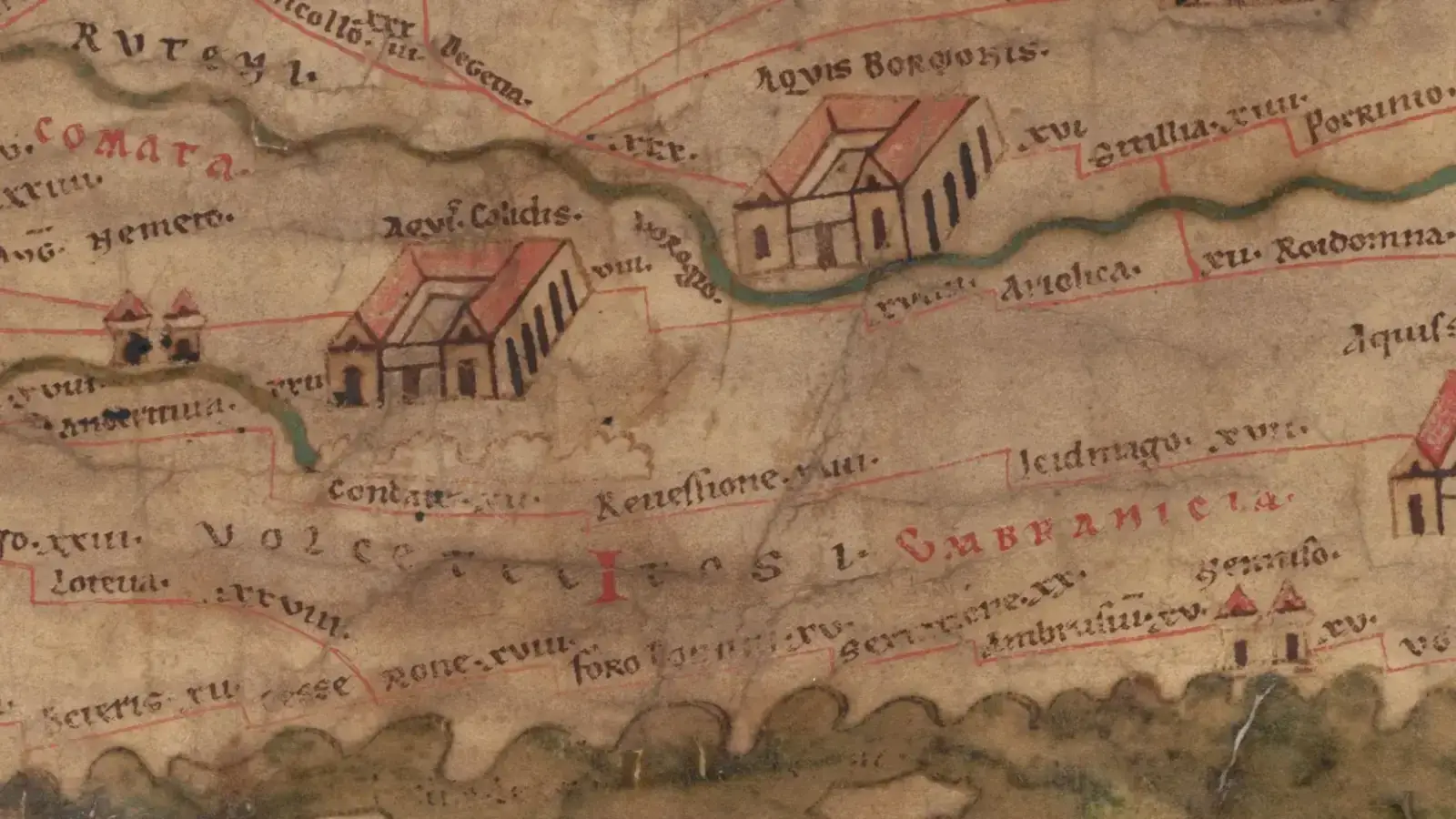
The word is old. It comes from Latin iter, a journey or road, through Late Latin itinerarium, and English has used it since the mid-15th century. Roman itineraria were lists of towns along a road with the distance between each one. The picture at the top of this page is part of the Tabula Peutingeriana, a medieval copy of a Roman road map that is 6.75 metres long and has been in Vienna since 1738. It’s a 2,000-year-old itinerary, and it records exactly what yours should: where the stops are and how far apart.
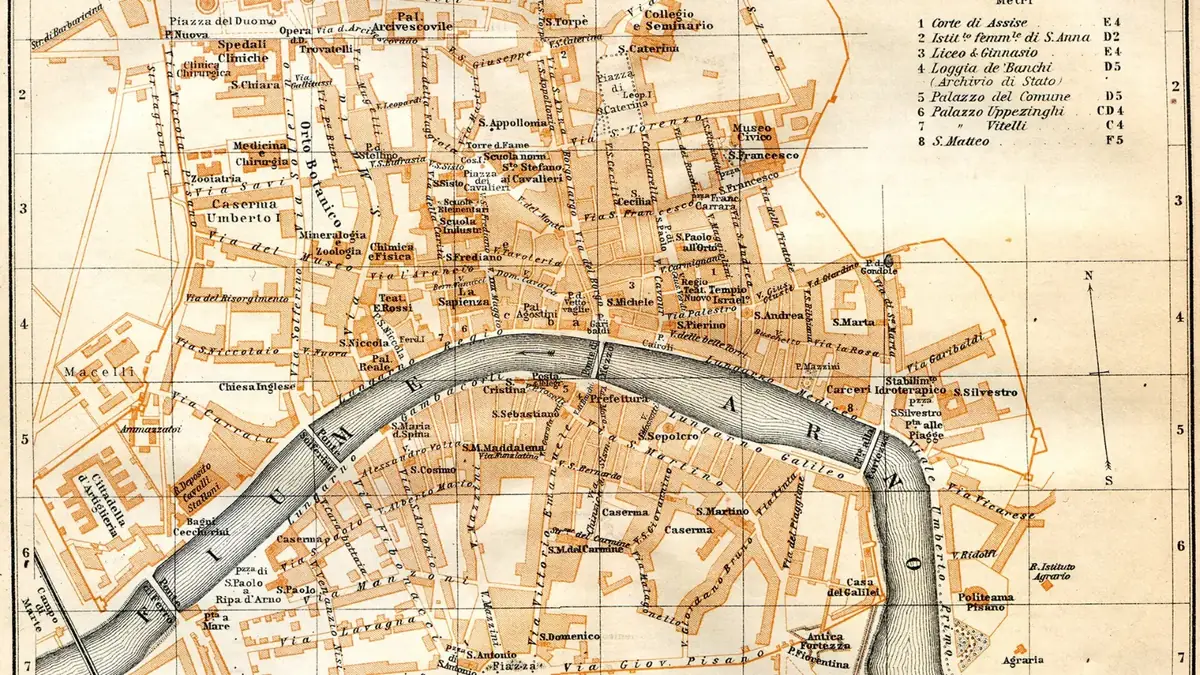
The sense most people mean today, a sketch of a trip you’re about to take, appears in print from 1856, according to the Online Etymology Dictionary. For the meanings in detail, and how to read the codes on an airline itinerary, see what a travel itinerary is.
What are the different types of itineraries?
Most pages list trip styles (adventure, family, business) and call those the types. That mixes up several separate choices. In practice, itineraries differ in five ways, and one trip makes a choice on each:
| How itineraries differ | The options | What it changes |
|---|---|---|
| The document | A travel plan you write; an airline itinerary (the e-ticket receipt); a visa itinerary for a consulate | What it must contain and who reads it |
| Level of detail | A route only; day by day; timed to the hour | How much you check in advance |
| Shape of the route | One base; a line of cities; a loop; hub and spoke (day trips from one base); open jaw (fly into one city, out of another) | How many hotel moves and long journeys there are |
| Who it’s for | Solo, couple, family, group, business | Pace, rest, rooms and how decisions are made |
| Who made it | You; a tour operator (ready-made or tailor-made); an AI tool | How much of it has already been checked |
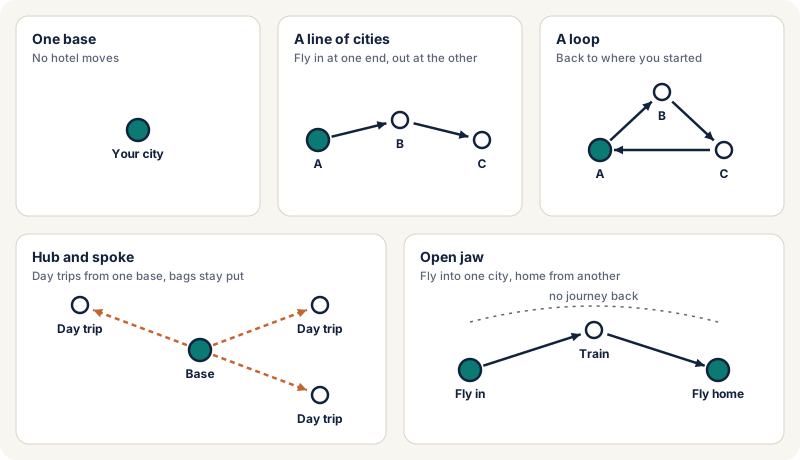
A three-day city break is usually one base, day by day, for a couple, made by you. A ten-day trip through Italy is a line of cities with timed train days. The labels matter less than the consequences: every change of base costs part of a day, and every extra person makes the slowest part of the day slower.
What should every itinerary include?
At minimum: your dates, where you sleep each night with check-in and checkout times, the things that are booked, and the order you’ll do things in each day. A useful one also says how you’ll get from each place to the next and what you’ll drop if the day runs late.
The full checklist, with what to record for each part, is in what a travel itinerary should include, and the free travel itinerary template gives you the columns ready-made in Excel, Word or PDF.
How much detail does an itinerary need?
Less than you’d think for the free time, more than you’d think for the travel days. Timed detail is worth it where a mistake costs money or a missed connection. Everywhere else, morning and afternoon blocks are enough.
| Trip | Detail that pays off | Where to keep it loose |
|---|---|---|
| Weekend city break | One area and one main sight per half day | Meals, shops, the walk between |
| A week in one city | Timed tickets and the arrival and departure days | Two or three days with only one fixed plan |
| Several cities | Every train or flight, with the time you must leave the hotel | Sightseeing on move days |
| Family with young children | Naps, meals and the last stop before tiredness | Anything that can be dropped without tears |
| Business trip | Meetings, transfers and the latest flight you can make | The evenings |
| Visa application | Dates, cities, accommodation and flights, matching the bookings | Day-to-day sightseeing (consulates don’t need it) |
For a sense of scale, Amicly’s own planner writes 3 to 4 stops a day at a relaxed pace, 4 to 6 at a balanced pace and 6 to 7 at a packed one, with meals counted as stops. Its checker flags any day with more than 8 stops or more than 3 hours of travel. If your plan is past either line, how many things to do in a day explains what to cut first.
How do you make an itinerary that works?
Start with what can’t move, then work out how many usable hours each day really has. Arrival and departure days are the ones people get wrong. With Amicly’s timing rules (be at the airport 3 hours before an international flight, and allow the transfer plus at least 15 minutes for traffic), a checkout at 11:00 and an 18:00 flight with a 45-minute transfer leave you about three hours, not a day.
After that: one area per day, one main thing per half day, every closing day checked against your dates, every journey timed, and meals and rest written in. The seven steps, with a Paris plan that fails and the fixed version, are in how to make a travel itinerary. If you’re travelling with children or moving between cities, the family itinerary and multi-city itinerary guides add the rules that change.
How do you check an itinerary before you travel?
Check four things for every day: that each place exists and is the one you meant, that it’s open on that date at that time, that the journeys between stops fit the gaps, and that the day isn’t simply too much. Most broken plans fail one of those four.
It matters more now that so many plans start in a chatbot. In an Expedia Group survey run by YouGov in March 2026, 40% of more than 5,700 adults in the US, UK and India said they use AI to help build itineraries. When the agency SEO Travel checked 100 ChatGPT itineraries in 2024, 90% had at least one error and 52% scheduled a visit outside opening hours.
You can run the checks by hand in about ten minutes with this checklist for AI itineraries, or paste the plan into Amicly’s Check my itinerary, which looks up each place on Google Maps, times the journeys with Google Routes and lists problems first. To compare the AI planners themselves, see the AI itinerary generator guide.
What do real itineraries look like?
Concrete ones teach more than templates. Our itinerary examples are four dated plans, each checked against the official opening days for its dates:
| Example | Shape | The catch it shows |
|---|---|---|
| A weekend in Lisbon | One base, day by day | Belém’s two big sights both close on Mondays |
| Five days in Rome in December | One base, timed tickets | The Vatican Museums close on Sunday 6 and Tuesday 8 December |
| Seven days in Japan | A line of cities by Shinkansen | Large suitcases need a reserved seat |
| Three days on business | Timed | Working back from the latest flight you can make |
How should you keep and share an itinerary?
Keep one current version and make sure everyone travelling can open it without a signal. Save tickets and confirmations separately, because a line in a plan is not a booking. Offline maps help, but Google Maps doesn’t give transit or walking directions offline, so note the journeys you’ll need.
Amicly keeps your trips on your phone and opens saved plans offline. For everything a phone should hold before you leave, see how to prepare your phone for international travel.
All itineraries guides
Each guide answers one question in depth. Start with the one that matches where you are.
Understand itineraries
What the word covers, and what real ones look like.
- What is a travel itinerary? Meaning, examples and how to read oneWhat itinerary means, the three documents people call an itinerary, how to read every code on a flight itinerary, and what a visa office actually asks for.
- Itinerary examples: four real trips, checked day by dayFour sample itineraries with real dates, a map each and official opening days: a Lisbon weekend, five December days in Rome, a week in Japan by Shinkansen and a three-day work trip.
Make your own
A method, a template and a sanity check for full days.
- How to make a travel itinerary, step by stepA seven-step method for a day-by-day plan that works on the ground, with a Paris draft that fails on closing days and the fixed version, plus opening days for 38 famous sights.
- Free travel itinerary template (Excel, Word and printable PDF)A free, no-sign-up travel itinerary template in Excel, Word and PDF, with a daily plan, booking list and a leave-by calculator for travel days.
- How many things to do in a day on vacation (and how to avoid an overcrowded itinerary)Two main things a day, four to six stops with meals, fewer on travel days. Here's the time budget behind that, with official visit lengths for famous sights and an overloaded day fixed.
Plan for your kind of trip
Children, several cities, and the rules that change with them.
- Family travel itinerary: how to plan days that work with childrenHow many hours children can really sightsee by age, the shape of a day that works, and a dated two-day London plan with a map, opening hours and walking distances.
- Multi-city itinerary: how to plan a trip through several citiesHow long a move between cities really takes (door-to-door times for 18 train routes), how many nights each city needs, which order to go in, and a ten-day Italy plan built around its move days.
- Jet lag with kids: how to get through the first day after an overnight flightDaylight, local mealtimes, short naps and an early night, plus what to do with the hours before the hotel room is ready. With a sample landing day by age.
Use AI without getting caught out
Which tools do what, and how to check what they give you.
- AI itinerary generator: what each tool checks, and how to use one wellThirteen AI trip planners compared on what their makers say they check, book and export, what the 2024 to 2026 studies found about AI itinerary errors, a prompt that works, and the 12 checks Amicly runs in code.
- Can you trust an AI travel itinerary? How to check one in 10 minutesAI is good at a first draft and bad at facts that change. Here’s what the 2026 surveys found, the mistakes that strand people, and a 10-minute check for any plan.
First and last days
The hours between landing and check-in, and between checkout and the flight.
- What to do before hotel check-in (when you land hours early)Go to the hotel first, then fill the gap nearby. With official check-in times and early check-in rules for 12 hotel chains, a plan for each landing time, and an email to send before you fly.
- Where to store luggage after hotel checkout (and before check-in)Ask the hotel first, then a staffed desk or locker on your route, then a storage app. Prices from London, Tokyo, Paris, Rome and New York, and what each option really covers.
- How early to get to the airport for an international flightThree hours is the standard answer. Here’s where it comes from, the airline deadlines that really decide whether you fly, and how to work out when to leave.
Questions about itineraries
What is the plural of itinerary?
Itineraries. The word comes from Late Latin itinerarium, a record of a journey, and English has used it since the 15th century.
How do you pronounce itinerary?
Eye-TIN-uh-ruh-ree, with the stress on the second syllable. The Oxford Learner’s Dictionary gives it as /aɪˈtɪnərəri/.
Is a flight itinerary the same as a travel itinerary?
No. A flight itinerary is the airline’s record of your flights, with airports, times and a six-character booking reference. A travel itinerary covers the whole trip, including where you sleep, what you do and how you get between places.
What is a visa itinerary?
It’s the travel plan a consulate asks to see with a visa application. Schengen checklists from EU delegations and embassies ask for a flight reservation including the return, proof of accommodation for the whole stay, and documents showing the planned trip. Follow the checklist of the consulate you apply to, because each one publishes its own.
What’s the difference between an itinerary, a schedule and an agenda?
A schedule is a list of times. An agenda is the running order of a meeting or event. An itinerary is about movement, so it joins the timed parts of a trip to the journeys between them and the places you stay.
How far ahead should I plan an itinerary?
Fix the bookings that sell by time slot as soon as your dates are certain. Some open only a short window ahead, such as the Colosseum, whose tickets go on sale 30 days before the visit. The rest of the plan can wait until a week or two before you go, when you know the weather and how much energy you’ll have.
Can I make an itinerary for free?
Yes. A document, a spreadsheet or Amicly’s free travel itinerary template in Excel, Word or PDF all work. In Amicly, your first AI trip plan and your first itinerary check are free with a free account.
Sources
- Merriam-Webster: itinerary · checked 29 October 2026
- Oxford Learner’s Dictionaries: itinerary · checked 29 October 2026
- Online Etymology Dictionary: itinerary · checked 29 October 2026
- Wikipedia: Tabula Peutingeriana · checked 29 October 2026
- Wikimedia Commons: Tabula Peutingeriana (ÖNB) 01, Rodez to Lyon · checked 29 October 2026
- Wikimedia Commons: Baedeker, plan of Pisa · checked 29 October 2026
- EU Delegation: general Schengen visa requirements (checklist) · checked 29 October 2026
- Embassy of the Czech Republic: Schengen visa application checklist · checked 29 October 2026
- Expedia Group and YouGov: the AI trust gap (April 2026) · checked 29 October 2026
- Travolution: SEO Travel study of 100 ChatGPT itineraries (May 2024) · checked 29 October 2026
- Colosseum: opening times and tickets · checked 29 October 2026
How we review · Amicly facts on this page come from the app’s own rules.