Itineraries guide · Arrival and departure
Jet lag with kids: how to get through the first day after an overnight flight
Daylight, local mealtimes, short naps and an early night, plus what to do with the hours before the hotel room is ready. With a sample landing day by age.
Short answer. On the first day, get the children outside in daylight, eat at local mealtimes and keep naps short (a baby’s usual naps are fine; older children should nap briefly or not at all). Go to bed at a reasonable local time. Adults typically adjust by about an hour a day flying east and an hour and a half flying west. Don’t give melatonin to a child without talking to their doctor first.
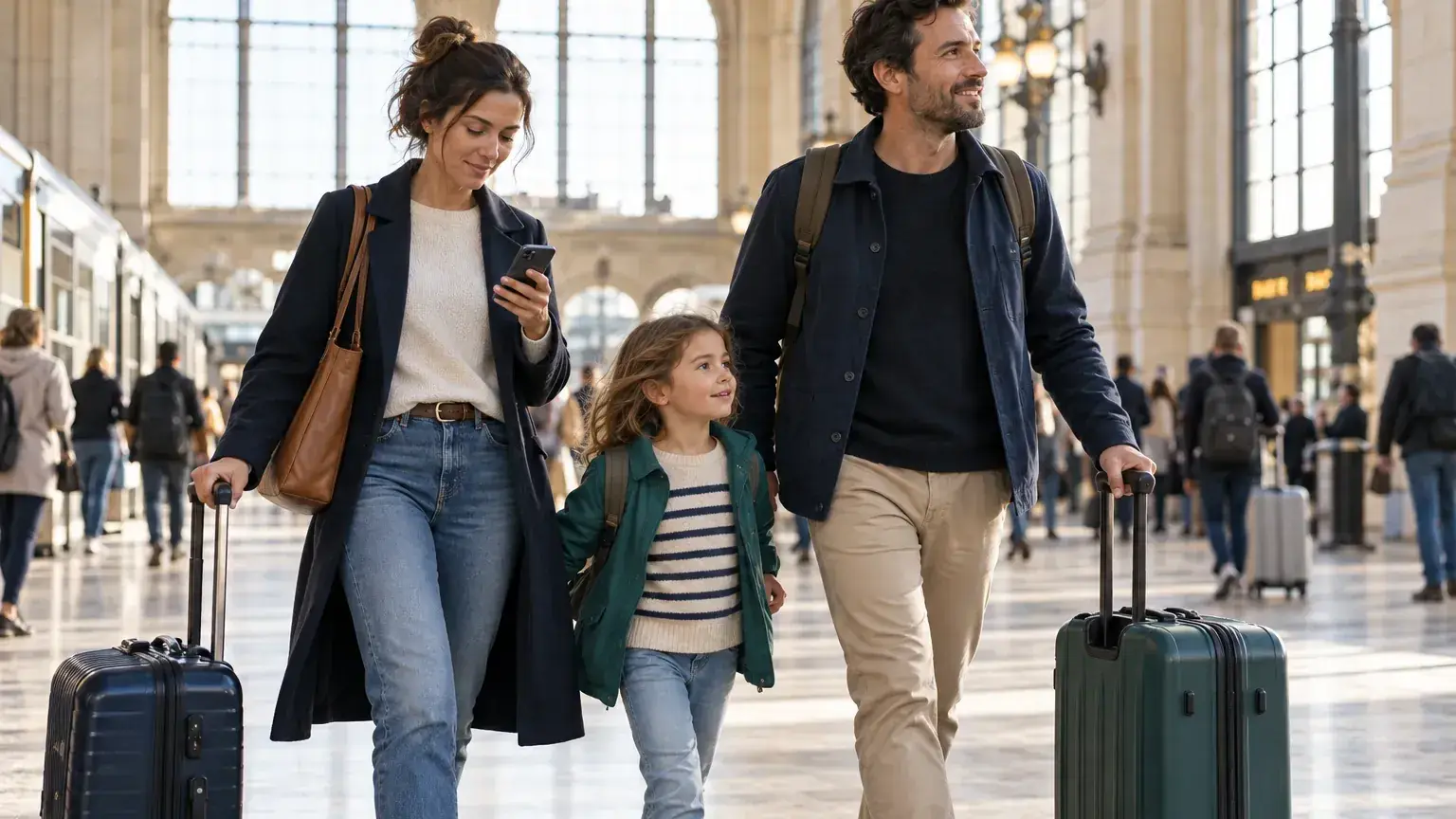
You land at 07:00 after a night of broken sleep. Your hotel room is ready at 15:00. Between those two times are eight hours, a pile of bags, and one or more children who are either asleep on your shoulder or wildly, hopelessly awake.
How you spend that first day does more for the rest of the trip than anything you pack. The good news is that the official advice is simple. The hard part is fitting it around a room that isn’t ready yet, and that’s what most of this guide is about.
A note before we start: this is practical travel advice, not medical advice. If your child has a health condition, or you’re thinking about any sleep medicine, talk to their doctor.
How long does jet lag last in kids?
Usually a few days. The NHS says jet lag "usually improves within a few days". The CDC’s guide for doctors gives a rough pace for adults: the body clock shifts by about 1 hour a day after flying east and about 1.5 hours a day after flying west. Children vary: some settle faster than their parents and some more slowly, but the same direction rule holds. Flying east, where you lose hours, is usually the harder trip.
So for a six-hour time difference flying east, expect most of the first week to involve some early waking or late nights, getting better each day.
One exception: for very short trips, sleep specialists at Children’s National Hospital suggest that for trips under three days, it can make sense to stay on home time rather than adjust at all.
Should I let my child nap after an overnight flight?
Yes, but keep it short, and fit it to their age.
- Babies and young toddlers who still take regular naps can keep them. Try to time them by the local clock rather than letting one nap turn into a four-hour sleep.
- Preschoolers do best with one nap, kept short and finished by early afternoon. Wake them gently if you need to; it’s easier than a 23:00 bedtime.
- School-age children and teenagers should nap briefly or not at all. The CDC says short daytime naps of 20 to 30 minutes help with alertness, and that longer naps may interfere with sleep that night. The NHS goes further and suggests only sleeping at night.
The aim is a first bedtime at roughly normal local time, maybe a little early. Getting there matters more than how tidy the day looks.
How do you help a child get over jet lag faster?
Four things, in this order of importance:
- Daylight. Get outside, ideally in the morning after flying east. The CDC explains that light at the right time is what moves the body clock; the American Academy of Pediatrics (AAP) also suggests getting outdoors, or into bright indoor light, during the day after arrival.
- Local mealtimes from the first meal. Breakfast at breakfast time, lunch at lunchtime, an early dinner, even if nobody is very hungry.
- Short naps or none, as above.
- A normal bedtime routine at a reasonable local hour, with the room dark.
Before the trip, the AAP suggests shifting your child’s sleep schedule over the two or three days before you leave. Even 30 minutes a day towards the new time zone helps.
Is melatonin safe for kids with jet lag?
Don’t give it without talking to your child’s doctor first. That’s the clear advice from the AAP and the American Academy of Sleep Medicine. A few reasons to take it seriously:
- In the US, melatonin is a supplement, not a medicine, and isn’t regulated by the FDA. The American Academy of Sleep Medicine reports a study in which products contained anywhere from less than half to more than four times the amount on the label.
- The AAP notes more than 260,000 reports of children swallowing melatonin between 2012 and 2021.
- The NHS says melatonin isn’t recommended on the NHS for jet lag, because there isn’t enough evidence that it works.
Daylight, meals and bedtime do the heavy lifting anyway.
What do you do if you arrive before hotel check-in with kids?
This is the bit the jet lag advice leaves out. Here’s what works.
Before you travel, email the hotel. Say when you land, that you have young children, and ask:
- Can we check in early, and is there a charge?
- If not, can you hold our bags and message us when the room is ready?
- Is there anywhere we can wash and change: a lounge, a gym shower, a pool changing room?
- Can the cot be set up, and do the rooms have blackout curtains?
Some hotels sell guaranteed early check-in, and for a 07:00 landing with a baby it can be worth booking the room from the night before. It costs a night, but it buys the whole family a bed at 09:00.
When you land, go to the hotel first, even if the room won’t be ready. Drop the bags, ask again about early check-in, and leave a phone number. Then plan the gap close to the hotel, so you can get back quickly when the room is ready. Our guide on what to do before hotel check-in has more on this, and if the hotel can’t hold bags, see where to store luggage.
A sample first day after an overnight flight
Here’s a landing day for a 07:00 arrival with check-in at 15:00, flying east. Adjust the times to yours.
| Time | Under 2 | Ages 2 to 5 | Ages 6 and up |
|---|---|---|---|
| 07:00 | Land, passport control, bags | Same | Same |
| 08:30 | Taxi or train to the hotel (car seat sorted, see below) | Same | Same |
| 09:30 | Bags to the hotel desk, change of nappy and clothes | Bags to the desk, wash faces, change tops | Bags to the desk, freshen up |
| 10:00 | Breakfast nearby | Proper breakfast nearby | Proper breakfast nearby |
| 11:00 | Morning nap in the pram, outdoors if you can | Park or playground in daylight | A walk, a park or an easy outdoor sight |
| 12:30 | Lunch | Lunch | Lunch |
| 13:30 | Afternoon nap at the usual time | One short nap (pram, or a quiet corner), done by 14:30 | No nap, or 20 to 30 minutes at most |
| 15:00 | Check in, cot set up, bath | Check in, unpack, bath or swim with a rested adult | Check in, shower, quiet time |
| 17:30 | Early dinner | Early dinner | Early dinner |
| 19:00 | Usual bedtime routine | Bedtime routine, a little early | Bedtime by about 20:30 local time |
Flying west, where you gain hours, the problem flips: children wake very early. Keep the first evening active and outdoors in the late afternoon light, and push bedtime later rather than earlier.
What should go in the day bag?
You’ll live out of it until 15:00, so pack it the night before you fly and put the most-needed things on top:
- A full change of clothes for each child, and a clean top for each adult
- Toothbrushes, wipes, nappies and a changing mat
- Water bottles and more snacks than seems reasonable
- Sun hats or sunglasses (bright light helps with jet lag, but not straight into tired eyes)
- The comfort toy or blanket
- Any medication, and a small first-aid kit
- A phone charger and power bank
- The hotel’s address saved on your phone, in the local language
Staying safe on the first day
Tired adults make more mistakes than tired children. A few things to decide before you’re exhausted:
- Car seats. Rules for taxis vary a lot by country. In the UK, for example, a child can ride in a licensed taxi without a car seat only in the back. The AAP suggests checking whether you can bring your own booster or car seat as luggage (often free) and checking the fit and condition of any you hire. Look up the rule for your destination before you book the airport transfer.
- Water. Pools and baths with an exhausted adult in charge are a bad mix. Swim with whoever slept on the plane.
- Crowds. Take a photo of each child that morning, so you know exactly what they’re wearing, and agree a meeting point.
- New rooms. Check balconies, windows and the cot before anyone falls asleep.
When will everyone feel normal again?
Expect two or three rough nights, and a noticeable improvement by the fourth or fifth day after a big time change. Plan the first full day lightly, with one main thing and lots of outdoor time, and save the long museum visit or the early-start tour for later in the week.
Amicly’s arrival planner builds this kind of first day for you. Tell it when you land, when you can check in, how many children and bags you have and how much energy you’ve got, and it plans the gap around them, with every estimate labelled.
Sources
- CDC Yellow Book: Jet lag disorder · checked 29 October 2026
- NHS: Jet lag · checked 29 October 2026
- HealthyChildren.org (American Academy of Pediatrics): Melatonin and children's sleep · checked 29 October 2026
- American Academy of Sleep Medicine: Melatonin use in children and adolescents · checked 29 October 2026
- HealthyChildren.org (American Academy of Pediatrics): Travel safety tips · checked 29 October 2026
- Children's National Hospital: Managing your child's jet lag · checked 29 October 2026
- GOV.UK: When a child can travel without a car seat · checked 29 October 2026
Spotted something out of date? Report a correction. How we review