Itineraries guide · Arrival and departure
Where to store luggage after hotel checkout (and before check-in)
Ask the hotel first, then a staffed desk or locker on your route, then a storage app. Prices from London, Tokyo, Paris, Rome and New York, and what each option really covers.
Short answer. Ask your hotel to hold your bags; most do this for guests, free or for a small tip, before check-in and after checkout. If that doesn’t suit your route, use a staffed left-luggage desk or locker at a station on your way, or a storage app near where you’ll spend the day. Keep valuables and electronics with you, and plan to collect bags with time to spare.
Ask the hotel first. Holding a guest’s bags for a few hours before check-in or after checkout is one of the most ordinary things a hotel does, and it costs you a tip at most. The only real reasons to look further are a hotel that’s out of your way, a very long gap, or a place that doesn’t have a desk at all, like many apartments.
Here’s how to choose, with real prices from five cities and the small print that matters.
Will a hotel hold my luggage after checkout?
Almost always, if you’re a guest. Most hotels with a front desk keep a luggage room and will tag your bags and give you a ticket. Premier Inn, for example, says on its own FAQ that its teams "will be happy to store any bags" if luggage storage is available and you check out before 12:00. Big chains rarely publish a formal policy, but you’ll find the same service at almost any staffed hotel.
A few things are worth knowing:
- Ask at checkout, not at the door. Say when you’ll be back. Some hotels hold bags only for the same day.
- It’s usually free. A tip for the person who carries the bags is normal in places where tipping is normal (in the US, a few dollars per bag is common).
- Apartments and small guesthouses often have no desk. Ask the host before you book whether you can leave bags, and how you’ll get them back.
- Hotels you’re not staying at sometimes help, especially if you’ve had a meal there, but they don’t have to.
- Liability is limited. A hotel storage room is generally safe, but many US states cap a hotel’s liability for guests' property, often at a few hundred dollars. Don’t leave anything you can’t replace.
What are the options if the hotel can’t hold my bags?
Choose by where you’ll be, not just by price. A cheap locker on the wrong side of the city costs you an hour.
| Your situation | Best option | Why |
|---|---|---|
| Hotel is near where you’ll spend the day | Hotel bag hold | Free, and you pass it on the way out |
| Leaving by train later | Station left luggage or lockers | Bags are already where you need them |
| Flying later, airport has a desk | Early airline bag drop, or airport left luggage | No collection trip at all |
| Gap of under 3 hours, bags small | Keep them with you, or a café or museum cloakroom | Storage costs more time than it saves |
| Gap of 3 to 10 hours, sightseeing elsewhere | Storage app near your plans | Shops and hotels in many neighbourhoods |
| Arriving early, no hotel desk (apartment) | Storage app near the apartment, or a station desk | Ask the host about early drop-off first |
Early bag drop at the airport deserves a mention. Many airlines open bag drop several hours before an international flight. American Airlines, for example, says that at many airports you can check bags up to 4 hours before departure. If your flight leaves at 22:00 and you’re done by 17:00, dropping your bags at the airport and travelling back into the city with a day bag is sometimes the simplest plan of all. Check your airline’s page for your airport first.
How much does luggage storage cost?
These are the prices on each operator’s own page, checked on 29 October 2026. They change, so treat them as a guide.
| Where | Type | Price |
|---|---|---|
| London Heathrow (Terminals 2 to 5, arrivals) | Staffed desk, Excess Baggage Company | £10 up to 3 hours, £15 for 3 to 24 hours, per item |
| London King’s Cross and Paddington | Staffed desk, Excess Baggage Company | Open 07:00 to 23:00; the operator lists prices "from £6" |
| Tokyo Station (inside the ticket gates) | Coin lockers | ¥400, ¥500 or ¥600 a day by size; up to 3 days |
| Tokyo Station | Staffed same-day storage | ¥600 per piece, until 20:30 |
| Paris Gare du Nord (level −1, facing platform 3) | Lockers | €4 up to 4 hours, €7.50 for 4 to 12 hours, €9.50 for 12 to 24 hours |
| Rome Termini (Via Giolitti, near platform 24) | Staffed desk (KiPoint) | Open 07:00 to 21:00; price not published on the official station page |
| US Amtrak stations, where offered | Staffed bag storage | $10 per item for 24 hours for ticketed passengers; $20 for others, with photo ID |
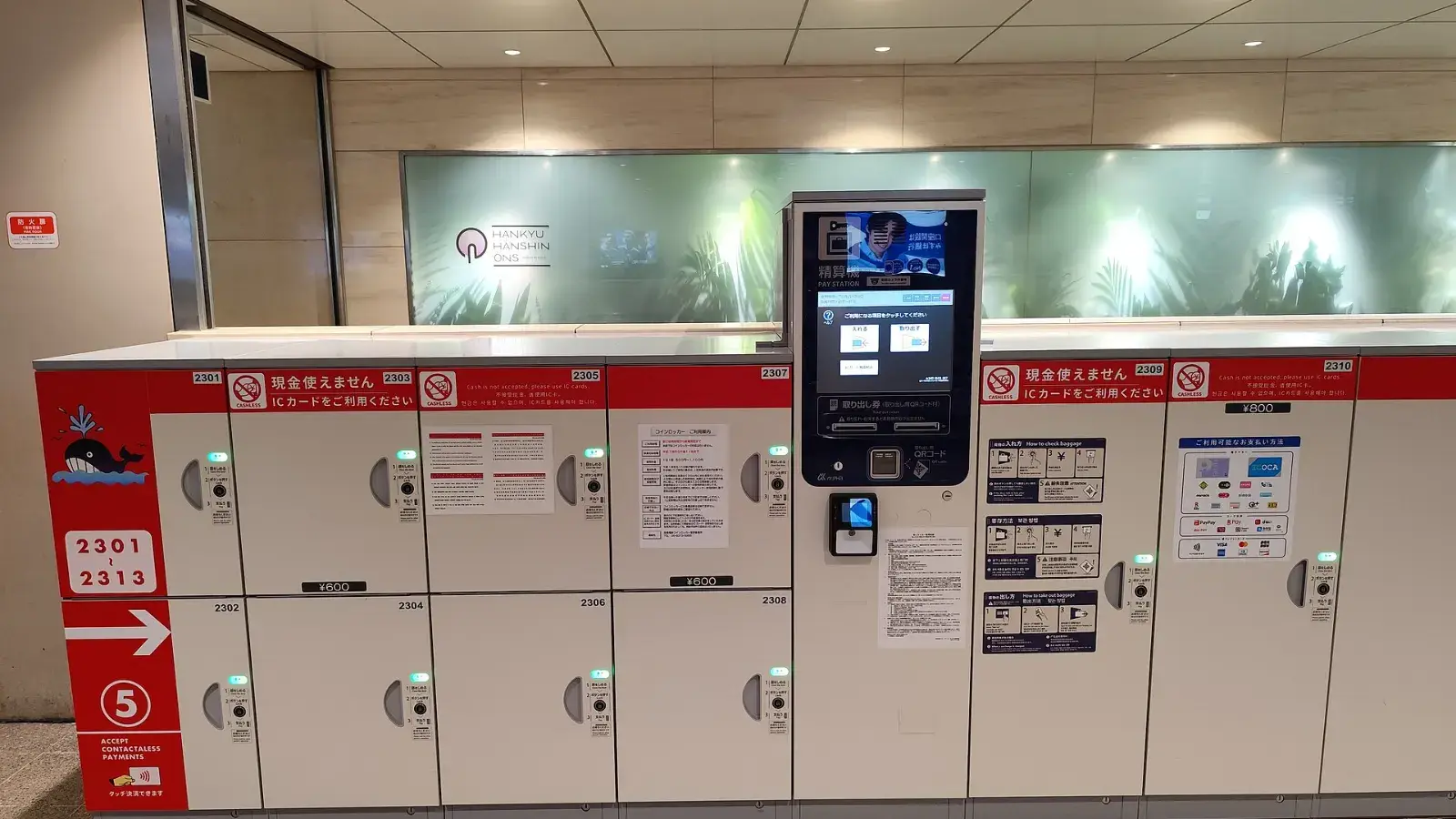
Some lockers in Japan don’t take cash at all. The ones in this guide’s photo, at Osaka Station in June 2026, carry signs saying cash can’t be used and asking you to pay with an IC card (a transport card such as Suica or ICOCA), so have one loaded before you need a locker.
The Paris station page warns that its lockers "often fill up". In the US, don’t count on station or airport lockers at all: big stations like New York Penn Station are built around staffed desks, and the service isn’t offered everywhere. Check the station’s own page before you plan around it.
Are luggage storage apps safe?
Mostly, yes, and they’re handy when there’s no hotel or station on your route. Apps like Bounce, Radical Storage, Nannybag, LuggageHero and Stasher partner with shops and hotels that hold bags for a fee. You book a spot, show a code, and the shop tags your bag.
Read two things before you book, because they differ a lot:
The real price. Headline prices start low (Bounce lists London storage "from £1.95" a bag, Radical Storage "from €3.90" a bag a day), but some add fees. LuggageHero, for example, charges £4.90 a day plus a £1.80 service fee per bag in London.
What the cover actually covers.
| App | Cover it advertises | Worth knowing |
|---|---|---|
| Bounce | "Up to £10,000 per booking" (London page) | It says this "isn’t insurance"; report problems within 24 hours of the booking ending |
| Radical Storage | €10,000 per bag | Electronics, cash, jewellery and passports are excluded; report within 7 days, and to the police within 48 hours if something is stolen |
| LuggageHero | £500 included | Extra cover is optional |
| Stasher | £10,000 per booking | Check the terms for exclusions |
In other words, the cover is for clothes and suitcases, not for your laptop or passport. Keep those with you.
There’s one more risk: collecting late. In one case reported by Elliott Advocacy in 2025, a traveller who picked up bags later than booked found them missing, and the company first called them "abandoned". Book until a time later than you’ll need, and message the shop if you’re delayed.
Amicly partners with Bounce for luggage links inside the app, and those links are always labelled. There are no partner links in this article, and the comparison above uses each company’s own published terms.
What should I keep with me in a day bag?
Pack it before you check out, so you’re not opening suitcases at a luggage desk:
- Passport, travel documents and any visa or entry printouts
- Phone, charger and a power bank
- Laptop, tablet or camera (most storage cover excludes electronics)
- Medication for the day, and anything a child needs
- A layer for the evening and a change of top for the flight
- Water and a snack
- Your booking code or ticket for the storage, and a photo of each stored bag and its tag
That last one takes ten seconds and makes any problem much easier to solve.
How much time do I need to collect my bags?
More than you think. Work back from your departure time, not forwards from your sightseeing:
- Find the time you need to be at the airport or station (for a flight, usually 3 hours before an international departure; see how early to get to the airport).
- Subtract the journey from your bags to the airport, plus a margin.
- Subtract 20 to 30 minutes for collecting the bags: a queue at the desk, finding the shop, a lift that’s out of order.
That last number is your "back at the bags by" time. Set an alarm for it.
If you’re at the start of a trip rather than the end, the same thinking applies the other way round. Our guide on what to do before hotel check-in covers the hours between landing and getting your room.
For six worked examples of the sum, and what to do with the hours it leaves you, see what to do after hotel checkout before a flight.
Amicly’s departure planner does this sum for you: tell it when you check out and when your flight leaves, and it works out when to be at the airport and when to leave, then plans the hours in between around your bags.
Sources
- Premier Inn: Arriving and departing FAQ · checked 29 October 2026
- American Airlines: Check-in and arrival times (early bag drop) · checked 29 October 2026
- UponArriving: Will a hotel hold your luggage? (hotel liability) · checked 29 October 2026
- Heathrow: Left luggage (operated by Excess Baggage Company) · checked 29 October 2026
- Excess Baggage Company: Station and airport locations · checked 29 October 2026
- Gransta (JR East group): Tokyo Station coin lockers and baggage storage · checked 29 October 2026
- SNCF Gares & Connexions: Paris Gare du Nord left luggage · checked 29 October 2026
- RFI: Roma Termini luggage services · checked 29 October 2026
- Amtrak: Baggage policy fact sheet (temporary bag storage) · checked 29 October 2026
- Wikimedia Commons: Osaka Station baggage coin lockers, June 2026 (CC0) · checked 29 October 2026
- Radical Storage: Terms and conditions · checked 29 October 2026
- Bounce: Luggage storage in London · checked 29 October 2026
- LuggageHero: London · checked 29 October 2026
- Elliott Advocacy: Can you trust Bounce with your luggage? (March 2025) · checked 29 October 2026
Spotted something out of date? Report a correction. How we review