Arrival and departure
What to do after hotel checkout before an evening flight
Work out your free window first, then pick one area and one thing to do. Six worked examples show how long the gap really is for different flights.
Short answer. First work out your free window. Take your flight time, subtract the time your airline wants you at the airport, the journey there and a margin, then subtract about 20 minutes to collect your bags. What is left after checkout is yours. Leave bags at the hotel or a nearby desk, choose one area and one main thing to do, and set an alarm for the time you must be back at the bags.
Your free window is the time between checkout and the moment you must be back at your bags. Work it out first, because it is almost always shorter than the gap between checkout and the flight. Then choose one area, one main thing to do, and one alarm.
This guide gives you the sum, six worked examples, and a plan to match each size of window. It doesn’t repeat the luggage comparison: for prices and storage options, see where to store luggage after hotel checkout.
How long is my free window between checkout and my flight?
Start from the flight and work backwards. Take the departure time, subtract the time you need to be at the airport, the journey there and a margin for traffic, then subtract the time to collect your bags. The result is when you must be back at the bags, and the hours between checkout and that moment are your free window.
Amicly’s departure rules use these numbers for the first three steps:
| Step | Rule used | Where it comes from |
|---|---|---|
| At the terminal before departure | 3 hours for international, 2 hours for domestic, 30 minutes for a train | Amicly’s departure timing, which calls these estimates and tells you to follow your airline |
| Traffic slack on the journey | The larger of 15 minutes or a quarter of the journey time | Amicly’s departure timing |
| Collecting bags | 20 minutes (our assumption, not a rule from an airline) | A queue at a desk, a lift, finding the shop |
Your airline’s own advice always wins. Some airports and airlines ask for more time, and a few ask for less. If you haven’t checked yours yet, how early to get to the airport explains how to find it.
What do the sums look like for real flights?
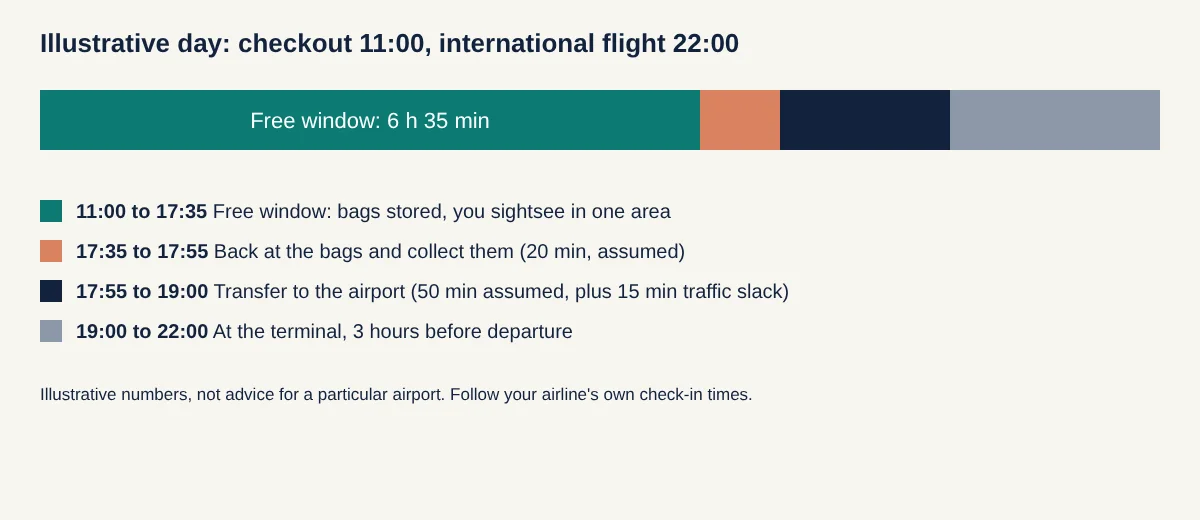
Here are six examples, all with checkout at 11:00. The transfer times are made-up round numbers for the illustration, so replace them with your own. Every row uses the rules above.
| Flight | Departs | Transfer | At terminal by | Leave by | Back at bags by | Free window |
|---|---|---|---|---|---|---|
| International | 22:00 | 50 min | 19:00 | 17:55 | 17:35 | 6 h 35 |
| International, long transfer | 22:00 | 100 min | 19:00 | 16:55 | 16:35 | 5 h 35 |
| International | 17:00 | 60 min | 14:00 | 12:45 | 12:25 | 1 h 25 |
| International | 14:30 | 50 min | 11:30 | 10:25 | 10:05 | None |
| Domestic | 20:00 | 40 min | 18:00 | 17:05 | 16:45 | 5 h 45 |
| Train | 19:30 | 15 min | 19:00 | 18:30 | 18:10 | 7 h 10 |
Three things stand out:
- A 22:00 flight doesn’t give you until 22:00. In the first row you have to be back at your bags at 17:35, which is more than four hours before departure.
- A 17:00 flight leaves a morning, not a day. With under an hour and a half, one coffee and a short walk is the whole plan.
- A 14:30 flight leaves nothing. You would need to leave the hotel at 10:25, before checkout, so go straight to the airport and have a slow breakfast there.
Amicly’s departure planner does this sum for you, using your own checkout and flight times, and plans the hours in between.
What should I do with a free window of under two hours?
Stay close to the bags. Have breakfast or a late coffee within a few minutes’ walk of the hotel, or sit in the lobby with your bags beside you if the hotel allows it. Use the time to charge your phone, download your boarding pass and save the airport route offline.
A second place is rarely worth it. Every extra stop adds a walk back, and with a window this small you have no spare minutes to lose.
What can I do with two to four hours?
Pick one thing within about 15 minutes’ walk of where the bags are. A small museum, a market, a park or a single viewpoint all work. Add a meal in the same area and head back with at least 15 minutes to spare.
Choose something you can leave at any point. A timed ticket for a large museum is a poor fit, because leaving half way wastes it.
What can I do with four to seven hours?
Choose one area, not several. Plan a main visit, a proper lunch and a quiet hour at the end. This is the size of window in the first and fifth rows above, and it is long enough for a real half day.
Keep the main visit close to the bags or on the line to the airport, so the way back to the bags and the way to the airport overlap. If the route goes across the city, add the journey to your sum before you commit.
Where should I leave my bags?
The simplest answer is the hotel, which will usually hold them for the day. Premier Inn’s own FAQ says its teams will be happy to store bags if storage is available and you check out before 12:00, and most staffed hotels offer something similar. Ask at checkout and say when you will be back.
If the hotel isn’t on your route, the other options are a station desk or locker, a storage app, or dropping bags at the airport early. The luggage guide linked above compares them with prices and what each one’s cover leaves out.
One option is worth thinking about early. As of 29 October 2026, American Airlines says on its check-in page that at many airports you can check bags up to four hours before departure. If your airline offers something similar at your airport, you can travel out with a small day bag and have no bags to collect at all. That changes the sum: you no longer need the 20 minutes for collection, and your free window ends at the airport instead of the hotel.
Can I get a later checkout or a room for the day?
Sometimes, but treat it as a bonus, not a plan. Ask at the front desk the evening before whether a later checkout is possible and what it costs. Hotels differ, and the answer may be a fee, a loyalty perk or a flat no. Don’t build your day around it unless you have it in writing.
What should I keep in a day bag?
Pack it before you check out, so you aren’t opening suitcases in a luggage room:
- Passport, boarding pass and any entry documents
- Phone, charger and a power bank
- Laptop, tablet or camera
- Medication and anything a child needs for the day
- A layer for the evening and a change of top for the flight
- Water and a snack
- Your storage ticket, and a photo of each bag with its tag
What is a good plan if it rains?
Switch to something indoors that you can leave at any time: a covered market, a café with a long table, a small gallery or a shopping arcade. Keep it inside the same area so a downpour doesn’t add a journey. Our guide to avoiding an overcrowded itinerary has more on keeping a day light.
What if I land at the other end and have the same problem?
The mirror image is the gap before check-in. The same idea applies: one area, light plans, bags somewhere safe. See what to do before hotel check-in.
Quick answers
Is it better to go to the airport early or sightsee? If your free window is under about two hours, go early and relax at the airport. With four hours or more, one bounded activity is usually better than waiting in a terminal.
How early should I go back for my bags? Allow the journey to the airport, a margin for traffic and about 20 minutes for collection, then set an alarm a little earlier than that. Our worked examples show the exact figures.
Do I need to tip for holding bags? Often a small tip is normal where tipping is normal, and some hotels don’t expect one. The luggage guide has the detail.
Plan the hours in between
Amicly’s departure planner takes your checkout time and flight time, works out when to be at the airport, and suggests what to do in the hours before. The numbers it uses are the ones in the table above, and it labels its transfer estimate as an estimate.
Sources
- Premier Inn: Arriving and departing FAQ · checked 29 October 2026
- American Airlines: Check-in and arrival times (early bag drop) · checked 29 October 2026
Spotted something out of date? Report a correction. How we review