Itineraries guide · Trip planning
Family travel itinerary: how to plan days that work with children
How many hours children can really sightsee by age, the shape of a day that works, and a dated two-day London plan with a map, opening hours and walking distances.
Short answer. Plan a family itinerary around sleep, meals and stamina rather than sights. Give each day one main thing in the morning, a long lunch and a rest at a set time, then something short and close by. Keep journeys between stops under about 30 minutes, stay near the first stop of most days, and keep the arrival day almost empty.
Children don’t ruin itineraries. Plans written for adults do, and then the children get the blame. A day that works for a six-year-old has fewer stops, shorter journeys and a rest that’s written in, not hoped for.
This guide is part of our guide to itineraries. It starts from how much children sleep, turns that into hours you can plan, and ends with two real days in London with times, a map and the opening hours checked for the dates.
How many hours of sightseeing can children manage?
Fewer than adults, and it depends mostly on sleep. The CDC’s recommended sleep ranges, based on the American Academy of Sleep Medicine consensus, give a starting point. The planning columns are our estimates for a city day, not medical advice:
| Age | Sleep per 24 hours (CDC) | Plannable sightseeing (our estimate) | Stops a day, meals included |
|---|---|---|---|
| 4 to 12 months | 12 to 16 hours, including naps | Two short blocks around naps | 2 to 3 |
| 1 to 2 years | 11 to 14 hours, including naps | 2 hours in the morning, 1 to 2 after the nap | 3 |
| 3 to 5 years | 10 to 13 hours, including naps | 2 to 3 hours in the morning, 1 to 2 after a rest | 3 to 4 |
| 6 to 12 years | 9 to 12 hours | 5 to 6 hours with a long lunch | 4 to 5 |
| 13 to 17 years | 8 to 10 hours | 6 hours, starting later | 4 to 6 |
For comparison, Amicly’s planner writes 3 to 4 stops a day at its relaxed pace and 4 to 6 at its balanced pace. With children under six, start relaxed. The youngest child sets the pace for everyone, even when the older ones could do more.
What does a good family day look like?
One main thing, a long break, one short thing. That’s the whole shape, and it survives most surprises:
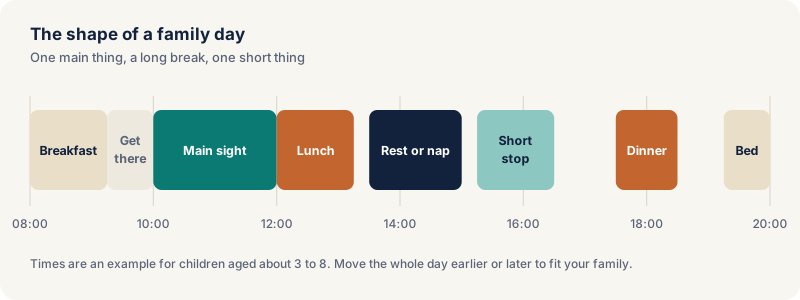
- Morning: the main thing, starting when it opens. Queues are shorter and children are freshest.
- Midday: lunch somewhere with space, then a real rest: the hotel, a park bench with a buggy, or a quiet café. Put it in the plan with a time.
- Afternoon: something short and close, which you can drop without anyone being disappointed. A playground counts.
- Evening: an early dinner near where you’re staying.
Keep journeys between stops to 30 minutes or less, door to door. Amicly’s checker flags any day with more than 3 hours of travel; with small children, half of that is already a lot. For the first day after a long flight, follow the advice in jet lag with kids and plan almost nothing.
An example: two days in South Kensington, London, with children aged 4 and 8
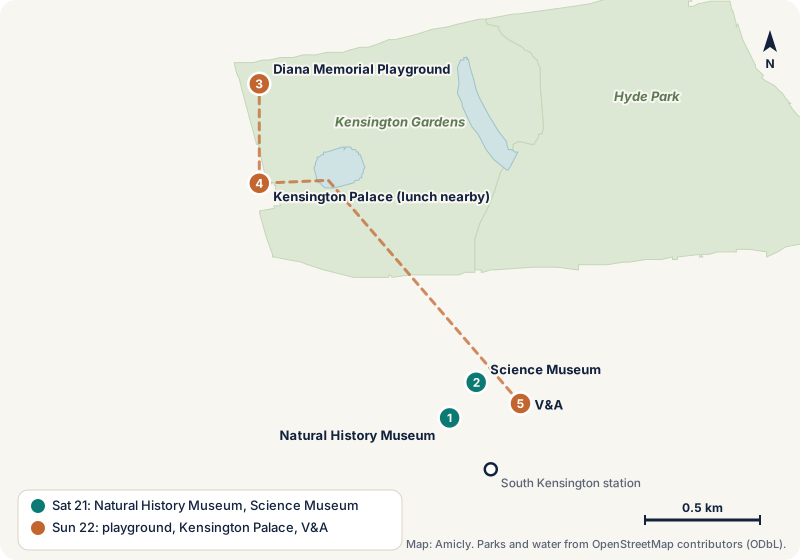
South Kensington is close to ideal for a family: three free national museums within a few hundred metres, and Kensington Gardens a short walk north. Here is a plan for Saturday 21 and Sunday 22 November 2026, with the hours each venue publishes, checked on 29 October 2026.
Saturday 21 November: museums
| Time | Stop | Why it’s here |
|---|---|---|
| 10:00 | Natural History Museum, dinosaurs first | Free; open daily 10:00 to 17:50, last entry 17:30. A free timed ticket guarantees entry |
| 12:00 | Lunch near Exhibition Road | Everyone stops before they’re hungry |
| 13:00 | Back to the hotel, rest | The 4-year-old needs it; the 8-year-old gets a book |
| 14:30 | Science Museum, Wonderlab | The museum is free but asks you to book a free ticket; Wonderlab is paid and cheaper booked ahead. Open 10:00 to 18:00, last entry 17:15 |
| 16:30 | Walk back, early dinner | The Science Museum is next to the Natural History Museum, about 200 metres away |
Sunday 22 November: the park and one gallery
| Time | Stop | Why it’s here |
|---|---|---|
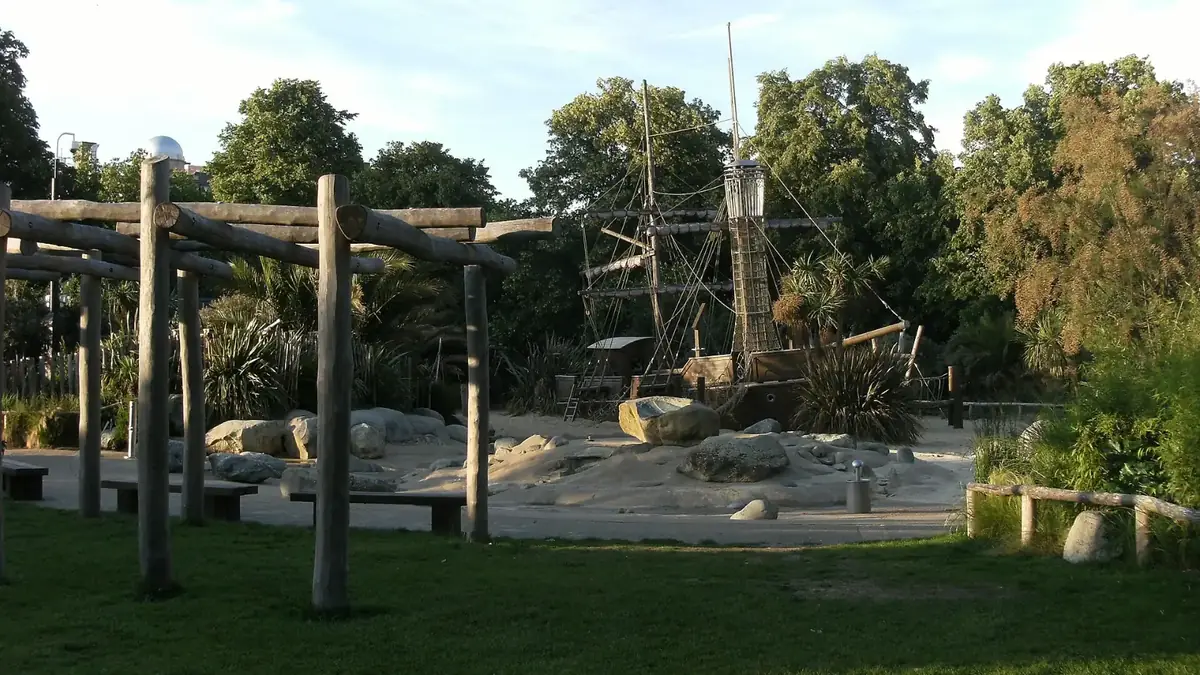
| 10:00 | Diana Memorial Playground, Kensington Gardens | Free. From November to January it’s open 10:00 to 15:45, so it has to be the morning. Adults are only let in with a child aged 12 or under |
| 12:00 | Lunch near Kensington Palace | Halfway back to the museums |
| 13:30 | Rest on the walk back through the park | The walk is about 1.7 km in a straight line; with small legs, allow 40 minutes or take a bus |
| 14:30 | V&A, one gallery only | Free, no booking needed; open 10:00 to 17:45 |
| 15:30 | Finish | Leave them wanting more |
Two things in this plan only show up when you check the dates. The playground’s winter closing time of 15:45 rules out an afternoon visit. And the Science Museum closes for a whole day on Wednesday 11 November 2026, which would have broken the same plan a week and a half earlier. One-off closures like that are listed on venues’ own visit pages, not in guidebooks.
If it rains, swap Sunday’s order: V&A in the morning, the playground only if it clears. The British Museum is the indoor backup, also free, but it’s across town in Bloomsbury, so treat it as a half day on its own.
Where should a family stay?
Within a short walk of the first stop on most days. The morning is when plans go wrong with children: breakfast, shoes, the forgotten toy. If the main sight is ten minutes away on foot, a slow start costs ten minutes rather than the slot you booked.
Two practical checks before you book a room:
- Can you get back for the rest? If the afternoon rest means the hotel, the hotel needs to be near the middle of most days.
- Can the room sleep everyone properly? A cot or a separate space for the child who naps matters more than a view.
How do you get around with young children?
Walk short distances, use public transport for anything over about 1.5 km, and check car seat rules before you rely on taxis. The rules vary by country:
- In the UK, if a licensed taxi or minicab doesn’t provide the right child seat, a child can travel without one, but only in a rear seat. Under-3s may travel without a seat belt; children aged 3 and over must wear an adult belt.
- In the EU, children under 1.35 metres must use a child restraint suited to their size and weight, and a rear-facing seat in the front is only allowed if the airbag is switched off. National rules on taxis differ.
- The CDC’s advice for travellers is that suitable car seats often aren’t available abroad and may need to be brought from home.
If you’re planning a road trip, those rules decide the luggage. For airport days with children, including how early to leave, see how early to get to the airport.
Which big museums are free for children?
Many of Europe’s largest are, which makes a short visit easy to justify. From the museums’ own pages, checked on 29 October 2026:
| Museum | Children’s entry | Weekly closing day |
|---|---|---|
| Louvre, Paris | Free under 18 (with ID) | Tuesday |
| Rijksmuseum, Amsterdam | Free for 18 and under | None (open daily) |
| Pantheon, Rome | Free under 18 | None (open daily) |
| British Museum, London | Free for everyone | None (closed 24 to 26 December) |
| Natural History Museum, London | Free for everyone | None (closed 24 to 26 December) |
| Science Museum, London | Free for everyone (Wonderlab is paid) | None, but closed all day on 11 November 2026 |
| V&A South Kensington, London | Free for everyone | None (closed 24 to 26 December) |
Free entry changes the maths. You can leave after 45 minutes without feeling you’ve wasted a ticket, which is often the right length of visit for a four-year-old.
What should be in the itinerary before you leave?
Beyond the daily plan, a family itinerary needs a few things written down that an adult trip can skip:
- Passports and consent. US passports for children under 16 are valid for 5 years and need both parents’ consent to issue. UK child passports are also valid for 5 years. Check expiry dates against the return date, not the outbound one.
- Health basics. The CDC’s family travel advice is that dehydration is the biggest risk when a young child has diarrhoea or vomiting, so pack oral rehydration salts. In heat, it advises plenty of fluids and loose, light-coloured clothing, and never leaving a child in a parked car.
- A backup for every main sight, indoors and close by.
- The hotel address in the local language, for taxis.
The free travel itinerary template has space for all of it, and how to make a travel itinerary covers the steps that don’t change with children.
Questions about family itineraries
How many activities a day with kids? One main thing and one short thing, plus meals. With children under six that’s 3 to 4 stops a day including meals; with school-age children, 4 to 5.
Should we plan around naps? Yes, if your child still naps. Put the nap in the plan at its usual home time, and plan the morning so you’re near the hotel or a pushchair-friendly park when it’s due.
How do we involve the children? Give each child one choice per day from a short list you’ve already checked. It costs nothing in planning and earns a lot of goodwill.
Is a packed itinerary ever fine with kids? For a day or two with older children, if the stops are close together. A packed day followed by a slow one works better than three balanced days in a row that are each slightly too much.
Can Amicly plan a family trip? Yes. Choose the relaxed pace and Amicly plans fewer stops a day, checks each place on Google Maps and times the journeys. Its arrival and departure planner also asks about your group and bags when it plans the hours before check-in.
Sources
- CDC: About sleep (recommended hours by age, AASM consensus) · checked 29 October 2026
- CDC: Infants and children and heat · checked 29 October 2026
- CDC Yellow Book: Traveling safely with infants and children · checked 29 October 2026
- GOV.UK: When a child can travel without a car seat · checked 29 October 2026
- European Commission: Road safety, children · checked 29 October 2026
- US Department of State: Children under 16 (passports) · checked 29 October 2026
- Natural History Museum: Visit · checked 29 October 2026
- Science Museum: Visit · checked 29 October 2026
- V&A South Kensington: Visit · checked 29 October 2026
- The Royal Parks: Diana Memorial Playground · checked 29 October 2026
- The Royal Parks: playground reopens after renewal (4 August 2026) · checked 29 October 2026
- British Museum: Visit · checked 29 October 2026
- Louvre: Admission · checked 29 October 2026
- Rijksmuseum: Opening hours and prices · checked 29 October 2026
- Direzione Musei Roma: Pantheon · checked 29 October 2026
- Wikimedia Commons: Natural History Museum London South Facade 2020 04 Detail (CC BY 4.0) · checked 29 October 2026
- Wikimedia Commons: Pirate ship, Diana Memorial Playground (CC BY-SA 3.0) · checked 29 October 2026
- OpenStreetMap contributors: park and water outlines (ODbL) · checked 29 October 2026
Spotted something out of date? Report a correction. How we review