Apps and preparation
International travel checklist: what to do 2 months, 1 month, 1 week and 1 day before you fly
A dated checklist for travelling abroad, with the 2026 entry-rule changes, passport validity rules, lead times from official advice and a printable PDF.
Short answer. Start two months before you fly. Check your passport’s issue and expiry dates against your destination’s rules, find out whether you need a visa or travel authorisation, check vaccinations at least 8 weeks ahead and buy travel insurance when you book. A month before, apply for any authorisation and book timed tickets. In the last week, save offline copies of everything, and on arrival go to the hotel first.
Most travel checklists are one long list: passport, insurance, adapter, sunscreen. Everything on them is true, but they don’t tell you the part that actually goes wrong, which is timing. A passport that’s fine today can be refused at a border because of its issue date. Vaccinations can need weeks. An authorisation can take days to come through.
So this checklist is organised by when to do each thing. It’s written for any destination, with the rules that changed in 2026, and there’s a printable PDF at the end to tick off.
What should be on an international travel checklist?
Documents, health, insurance, money, your phone and your first day, in that order of urgency. Here’s the whole timeline on one screen:
| When | What to do | Why then |
|---|---|---|
| 2 months or more before | Passport dates, visa or authorisation, vaccinations, travel insurance | Renewals and vaccinations take weeks; insurance protects you from the day you buy it |
| 1 month before | Apply for any ETA or ESTA, book timed tickets, check opening days, plan day 1, sort money and phone | Timed tickets sell out; opening days are checkable for your dates |
| 1 week before | Reconfirm bookings, weather, offline maps, backup copies, print insurance | Late changes, and making sure everything works without signal |
| The day before | Online check-in, leave-by time, charge and pack the day bag | Bag-drop deadlines are the airline’s, not yours |
| The day you land | Out of the airport, bags to the hotel, a light plan until check-in | The first six hours set the tone for the trip |
The UK government’s own checklist puts two items first: read the official travel advice for every country you’re visiting, and buy travel insurance as soon as you book. Both are free to start and both protect you from the day you do them.
What should you do two months or more before you travel?
Check your passport dates, find out whether you need a visa or travel authorisation, check your vaccinations and buy insurance. These are the things that take the longest or cost the most if they go wrong.
- Passport. Look at two dates, not one: when it was issued and when it expires. Some destinations care about both (see the table below). If you need to renew, do it now. In the UK, an online renewal costs £102, as of November 2026.
- Visa or travel authorisation. Check the destination’s official government site for your nationality. Many visitors who don’t need a visa now need an online authorisation instead, such as the UK’s ETA or the US ESTA. Use the official site only: GOV.UK warns that "other websites may charge more" and imitate government services.
- Health. GOV.UK advises checking what vaccinations you need and what health precautions to take at least 8 weeks before you travel. Book a GP or travel clinic appointment now if you might need one.
- Travel insurance. Buy it when you book, so it covers cancellation from the start. Tell the insurer about any medical conditions, including ones still being investigated, and check the policy covers every country and activity on your trip.
- Driving. If you’ll drive, check whether the country needs an International Driving Permit as well as your licence.
Which entry rules changed in 2026?
Three that catch travellers out, as of November 2026:
| System | Where | What it means for you | Cost |
|---|---|---|---|
| EES (Entry/Exit System) | 29 European countries using the system, including the Schengen area | Fully operational since 10 April 2026. Non-EU visitors on short stays register fingerprints and a photo at the border, and passports are no longer stamped. Nothing to do in advance, but allow extra time at border control, including when you leave | Free |
| ETIAS | The same European countries | Not in operation yet, and no applications are being taken. The EU says it will announce the start date several months ahead. It has set the fee at €20, to apply once ETIAS starts | €20 when it starts |
| UK ETA | UK, Jersey, Guernsey, Isle of Man | Most visitors who don’t need a visa need one, including people from Europe, the USA, Australia and Canada. Every traveller needs their own, babies and children included. You also need one to pass through UK border control on a connection | £20 |
| US ESTA | United States | Visa Waiver Program travellers need an approved ESTA before travel, by air, sea or land. GOV.UK notes the US now requires a selfie photo in the ESTA, so check an older one is still valid | Check the official ESTA site |
On EES, GOV.UK’s advice is practical: allow more time for immigration when you leave the Schengen area, because the checks can take place before boarding. Your EES record lasts 3 years.
Does your passport have enough validity left?
Check it against the destination’s rule, not a general one, because the rules differ. The three most common:
| Destination | Passport rule (as GOV.UK sets it out for British travellers) |
|---|---|
| Schengen area (most of the EU, plus Switzerland, Norway and Iceland) | Issued less than 10 years before the day you arrive, and expiring at least 3 months after the day you plan to leave |
| United States | Valid for the length of your stay |
| Many other countries | At least 6 months left when you arrive |
The Schengen issue-date rule is the one that surprises people: a passport renewed before 1 October 2018 can carry an issue date more than 10 years old and be refused even though it hasn’t expired. If you’re connecting through another country, check its rules too.
What should you do one month before?
Apply for any authorisation you still need, book the things that sell out, and plan your first day.
- Authorisations. If your destination needs an ETA, ESTA or similar and you haven’t applied, do it now, on the official site.
- Timed tickets. Museums, towers and tours with timed entry often sell out. Book them, and plan the rest of the day around those times.
- Opening days. Check the opening days and hours of your main stops for your actual dates. Public holidays and seasonal hours change them.
- Day 1. Write down your landing time, how you’ll get to the hotel and when you can check in. That gap needs a plan; our guide on what to do before hotel check-in covers it.
- Money. Have two ways to pay. GOV.UK points out that losing your phone can stop you completing two-factor authentication, so make sure you can still reach money without it.
- Phone. Decide between roaming and an eSIM, and install the apps your destination needs. Our guide to preparing your phone for international travel goes through it step by step. Some countries need more setup than others: for China, see how to use Alipay as a tourist.
What should you do one week before?
Reconfirm, download and back up. This week is about making sure everything still works when you have no signal and no paperwork.
- Reconfirm bookings and their times.
- Look at the weather and have an indoor option ready for each wet day.
- Download offline maps and translation packs for the places you’re going.
- Save a backup of your passport, bookings and insurance, and share it with someone at home. GOV.UK suggests keeping key details somewhere you can reach if you lose your phone.
- Print your health insurance documents and carry a copy, and pack a second photo ID that isn’t your passport.
- Read the latest official travel advice for your destination again.
What should you do the day before you fly?
Check in, work out when to leave and pack the day bag.
- Check in online and note your airline’s bag-drop deadline. That deadline, not the departure time, is what you must make.
- Work out your leave-by time. Amicly plans to be at the airport 3 hours before an international flight, then subtracts the journey and a traffic margin of at least 15 minutes. Our guide on how early to get to the airport for an international flight explains when to allow more.
- Charge your phone and power bank, and pack chargers and a plug adapter.
- Day bag: passport, cards, a little local cash or a card that works abroad, medicines and a change of clothes.
What should you do the day you land?
Go to the hotel first, leave your bags and keep the first hours light. Amicly’s planner allows about an hour from landing to leaving the airport, then the transfer, then 15 minutes to drop your bags. For an 08:30 landing with a 25-minute taxi, that means you’re free from about 10:10.
If your room isn’t ready until mid-afternoon, plan those hours near the hotel rather than across the city. Families can use our guide to arriving early with children.
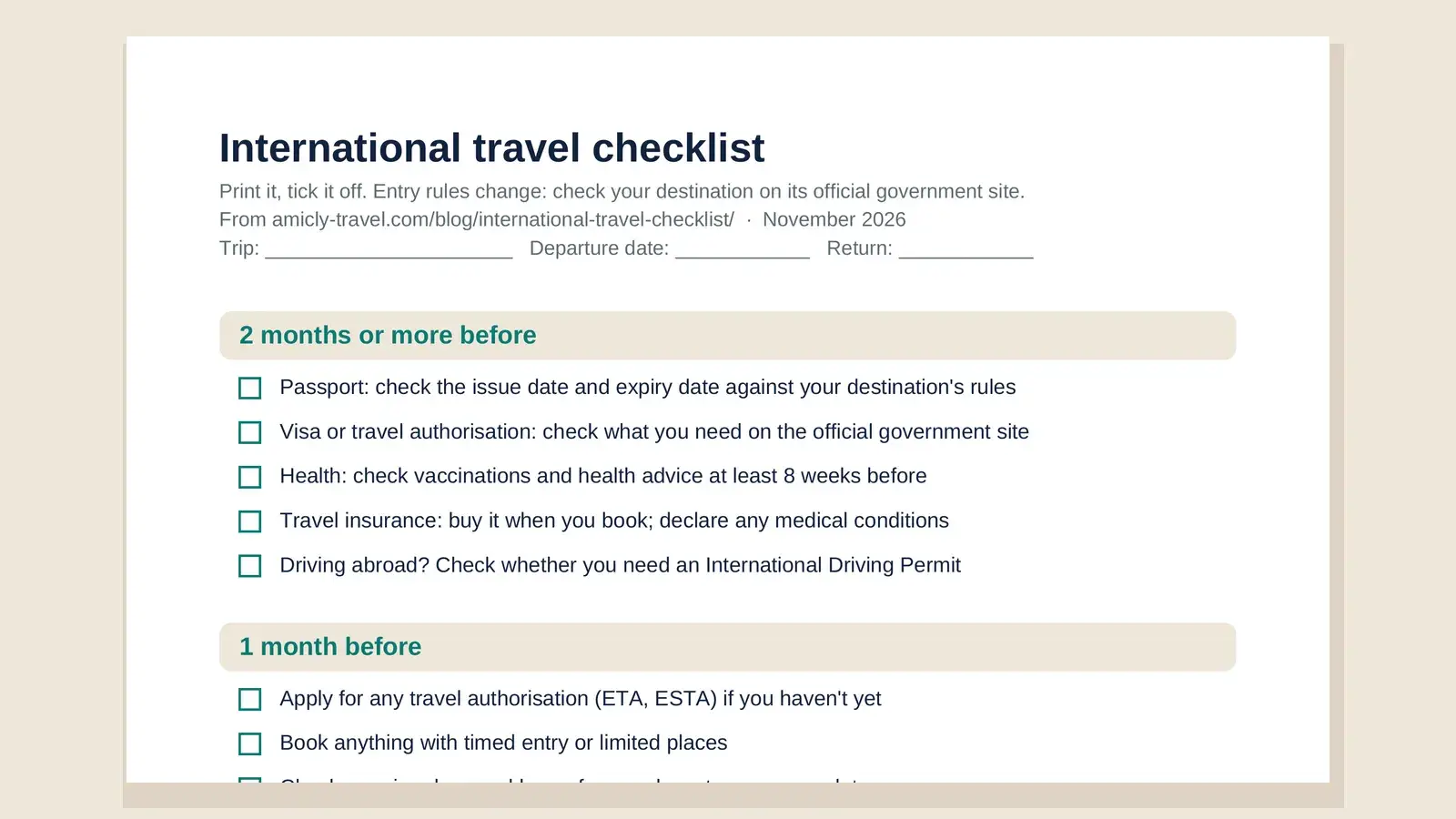
Download the printable checklist
The printable international travel checklist (PDF) has every item above under the same five headings, with tick boxes and space for your trip dates. It’s two A4 pages and prints well in black and white.
How can Amicly keep this checklist for you?
Every trip plan comes with its own dated "Before you go" list. Enter your dates and Amicly lists what to book now, what to check a month before (opening hours for every stop on your dates, your landing time and transfer) and what to do a week before (weather and rainy-day swaps, reconfirming bookings, opening the trip once so it works offline). One tap adds those dates to your phone’s calendar.
The same plan works out your day 1 from your landing and check-in times, keeps your bookings at their times, and checks every place on Google Maps. The Travel Kit lists the apps your destination needs, with a checklist to finish at home.
Your first trip plan, itinerary check, re-plan and arrival or departure plan per city are free. The Trip Pass costs $12.99 for 30 days, with no subscription, and covers 5 trip plans, 10 itinerary checks, 15 re-plans, 30 price checks and 10 arrival or departure plans.
Questions about preparing for international travel
How far in advance should I start preparing for an international trip? About two months, so there’s time for a passport renewal, vaccinations and any visa. Insurance is best bought the day you book.
Do I need ETIAS to visit Europe now? No. As of November 2026 ETIAS isn’t operating and no applications are being taken. The EU says it will announce the start date several months in advance. Avoid any site that offers to sell you one now.
What is the EU’s Entry/Exit System? A digital border record for non-EU visitors on short stays. Since 10 April 2026 it has replaced passport stamps: you give fingerprints and a photo at the border. It’s free and there’s nothing to do beforehand, but border queues can be longer.
How much does a UK ETA cost? £20 on GOV.UK, as of November 2026. Each traveller, including children and babies, needs their own.
Should I carry paper copies of my documents? Yes, for the important ones. GOV.UK suggests printing health insurance documents and having a backup of your passport, bookings and contacts that doesn’t depend on your phone.
What’s the one thing people forget? The passport issue date for Europe, and the plan for the first day. One gets you refused at the border; the other gets you a long, tired morning with your bags.
Sources
- GOV.UK: Foreign travel checklist · checked 6 November 2026
- GOV.UK: Get an electronic travel authorisation (ETA) to visit the UK · checked 6 November 2026
- European Commission, Migration and Home Affairs: Entry/Exit System (EES) · checked 6 November 2026
- European Commission, Migration and Home Affairs: ETIAS · checked 6 November 2026
- GOV.UK foreign travel advice: France entry requirements (Schengen passport rules and EES) · checked 6 November 2026
- GOV.UK foreign travel advice: USA entry requirements (ESTA and passport validity) · checked 6 November 2026
- U.S. Customs and Border Protection: Official ESTA Application Website · checked 6 November 2026
- Amicly printable checklist (PDF) · checked 6 November 2026
Spotted something out of date? Report a correction. How we review