Trip planning
How many days in Tokyo? A 1 to 7 day guide by what you want to do
Four to five full days suits most first visits to Tokyo. This guide shows what each length of stay holds, which day trips cost a full day, and a counter that adds up your own priorities.
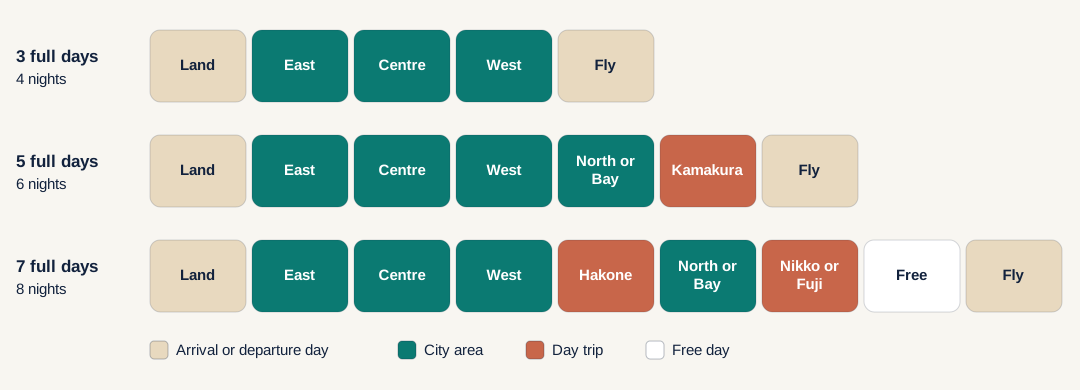
Short answer. Plan four to five full days for a first visit to Tokyo. Three full days covers the east (Asakusa, Ueno), the centre (Imperial Palace, Tsukiji, Ginza) and the west (Harajuku, Shinjuku, Shibuya). Each extra day adds one more area or one day trip, such as Kamakura or Hakone. Your arrival and departure days rarely count as full days.
Most first visits to Tokyo need four to five full days. Three is the floor: one day each for the east, the centre and the west of the city. Every day you add buys one more area or one day trip, and the right number depends on which of those you care about.
The days you land and fly home are the part most guides skip. A flight that lands at 17:00 and one that leaves at 10:00 take two calendar days and give you almost nothing to see, so count full days, not nights. Journey times and closing days below were checked on official pages; each section says when.
How many days do you need in Tokyo?
For a first visit, plan four to five full days. Three full days covers the three central areas at a walking pace; a fourth adds a second layer of the city or a day trip; a fifth gives you both. GO TOKYO, the city’s official tourism site, suggests at least five days to see the main highlights without rushing (page updated 11 March 2026).
| Full days | What fits | What to leave out | Good for |
|---|---|---|---|
| 1 | One area: Asakusa and Ueno, or Shibuya and Harajuku | Everything else | A long layover or a stop on the way to Kyoto |
| 2 | Two areas, usually the east and the west | The centre, any day trip | A short break inside a longer Japan trip |
| 3 | East, centre and west | Akihabara, the bay, day trips, Disney | A first look at the city |
| 4 | Three areas plus one: the north, the bay or a day trip | A second day trip | A first visit at a steady pace |
| 5 | Three areas, a fourth area and a day trip | A second Disney park, Nikko or Fuji as well as Hakone | Most first visits |
| 6 | Five days plus a second day trip or a theme park | Little on the main list | First visits with Disney or two day trips |
| 7 | Six days plus a free day | Nothing you’ll miss on a first visit | A relaxed visit, families, return trips |
This is our planning guide, built from the closing days and journey times on this page and our rule of one area or one day trip per day. It isn’t a survey of visitors. Read down the “leave out” column and pick the first row you can live with.
How many days do you need for your own list?
Tick what you want to do and choose your landing and flight times. The counter gives the full days, the hotel nights and an outline you can put in order.
How many days do you need in Tokyo?
Tick what you want to do and say when you land and leave. The answer updates as you change it.
–
Our planning rules: one area, one park or one day trip per full day. Arrival and departure days don’t count, though a morning landing or an evening flight leaves half a day for something light. Journey times are from JNTO, checked on 21 November 2026. Download the day trip times (CSV). Plan your Tokyo days in Amicly.
The counter uses three rules. A city area, a theme park or a day trip takes a full day. The Ghibli Museum counts as a day too: the visit is timed, it’s in Mitaka, west of Shinjuku, and it sits at the edge of Inokashira Park, which fills the rest of the day. Arrival and departure days don’t count, though a morning landing or an evening flight leaves half a day for something light near your hotel. Day trips with more than 3 hours of travel are flagged with the same limit Amicly’s planner uses: it warns about any day with more than 8 stops or more than 3 hours of travel.
Is 3 days in Tokyo enough?
Three full days is enough for the three central areas if you give each day one part of the city. It isn’t enough for day trips, Disney, or the north and bay areas as well. Treat it as a first look.
The order of the three days matters. The Tokyo National Museum, the Edo-Tokyo Museum and Shinjuku Gyoen close on Mondays (Shinjuku Gyoen opens every day during the cherry blossom season and the 1 to 15 November chrysanthemum show). The Imperial Palace East Gardens close on Mondays and Fridays, and Tsukiji Outer Market on Wednesdays, Sundays and public holidays. We checked these on the official pages on 13 November 2026.
Our 3 days in Tokyo itinerary gives each day by area and has a checker that puts the three days in the order that keeps the most sights open for your dates.
Is 4 or 5 days in Tokyo better?
Five days is better if you want one day trip; four is enough if you’d rather see more of the city itself. The fourth day is the north (Akihabara and Ikebukuro) or the bay (Toyosu, teamLab Planets and Odaiba). The fifth day is where a day trip fits.
With four days you choose: another city area or a day trip, not both. Kamakura is the easiest trade, at 55 minutes from Tokyo Station on the JR Yokosuka Line, according to JNTO. If shopping, anime or food halls are why you came, take the north instead and skip the day trip.
Is a week in Tokyo too long?
A week isn’t too long if you use two or three days for day trips or a theme park. Spent only in the city, seven days gives you time to go back to places you liked and to slow down. It’s the length we’d suggest for families, because a free day halfway through absorbs tired children, rain and jet lag.
Amicly plans up to 7 days at a time. If you’re staying longer, plan Tokyo as one trip and your day trips or the next city as another.
Which day trips from Tokyo cost a full day?
All of them, once you count the journey there and back. Kamakura and Hakone keep you under 3 hours on trains for the round trip; Nikko and Kawaguchiko, for Mount Fuji, don’t. JNTO gives these journey times (checked 21 November 2026):
| Day trip | Route from Tokyo | Each way | Round trip on trains | Over Amicly’s 3-hour flag? |
|---|---|---|---|---|
| Kamakura | JR Yokosuka Line from Tokyo Station | 55 min | About 1 h 50 min | No |
| Hakone | Odakyu Romancecar from Shinjuku to Hakone-Yumoto | About 1 h 20 min | About 2 h 40 min | No, but buses and boats inside Hakone add more |
| Nikko | Tobu limited express from Asakusa or Shinjuku | About 2 h | About 4 h | Yes |
| Kawaguchiko (Mount Fuji) | Direct limited express from Shinjuku | About 2 h | About 4 h | Yes |
Download the day trip times as a CSV, with the bus options and a source for each line. We didn’t check fares, first and last trains or seat availability, so we don’t quote them. JNTO says only a few direct trains to Kawaguchiko run each day, so look at the timetable before you choose a date.
A 4-hour round trip leaves a short day at the far end, especially in winter: Meiji Jingu, which opens from sunrise to sunset, closes at 16:00 in December. If Nikko or Mount Fuji matters to you, take the earliest train you can and keep the stops at the other end to two or three. One of the two is plenty for a five-day stay.
Do arrival and departure days count?
Usually not as full days. If you land after midday, the first day is check-in and a short walk. If your flight leaves before the evening, the last day is breakfast and the airport. Count nights minus one to get your full days, then take away any day you lose to flights.
Two cases give you half a day. A morning landing leaves an afternoon for the area around your hotel once your bags are dropped; Amicly’s planner allows 60 minutes to get through the airport before the journey into town even starts. An evening flight leaves a morning for something near your luggage. For real times, use Tokyo arrival day, which works out how much of the day is left after Narita or Haneda, and last day in Tokyo before a flight, which works back from your flight to a leave-by time.
Which weekdays should you plan around?
Monday changes a Tokyo plan more than any other day. The big museums in Ueno and Ryogoku shut, and so does Shinjuku Gyoen for most of the year. On a Monday, do the centre (Tsukiji and Hama-rikyu are open, only the palace gardens are shut) or a day trip.
| Day | What’s closed (from the official pages) | Use it for |
|---|---|---|
| Monday | Tokyo National Museum, Edo-Tokyo Museum, Shinjuku Gyoen, Imperial Palace East Gardens | The centre without the palace gardens, or a day trip |
| Wednesday | Tsukiji Outer Market (most shops) | The east or west |
| Friday | Imperial Palace East Gardens | The east or west |
| Sunday | Tsukiji Outer Market | The east or west |
A museum that opens on a holiday Monday usually closes the next day, and the year-end break closes most of these from late December. Check your dates against Japan’s public holidays.
What should you leave out of a short Tokyo trip?
On a stay of three or four days, leave out the day trips that need 4 hours on trains, a second theme park, and anything that sends you across the city twice in a day. Tokyo is large: a plan that puts Asakusa and Shibuya on the same morning spends that morning on the metro.
Leave out the timed tickets you can’t get, too. Ghibli Museum tickets go on sale at 10:00 Japan time on the 10th of each month for the following month. If you miss them, give that day to another area.
If the forecast is wet, you don’t need to cut a day. Our Tokyo rainy day itinerary has indoor routes for each area, so you can keep the area and change the stops.
How do you choose your number of days?
Start from the list, not the calendar. Work through these steps:
- Write down the areas and day trips you care about. One per full day.
- Add a day for the Ghibli Museum and Mitaka, and a full day for each Disney park.
- If you want a relaxed pace or you’re travelling with children, add a free day for every four.
- Add your arrival and departure days. They rarely count as full days.
- Mark any Monday, and give it the centre or a day trip.
- Put your real dates into Amicly’s planner, which builds the days around your pace and flags any day with too much travel.
Once you’re there, a Suica card on your phone makes the short hops easy; our Japan phone setup checklist covers iPhone and Android.
Quick answers
How many days in Tokyo is ideal? Four to five full days for a first visit. Three if Tokyo is one stop on a longer trip.
Is 2 days in Tokyo enough? For two areas, yes. Choose the east (Asakusa and Ueno) and the west (Shibuya, Harajuku and Shinjuku), and skip day trips.
How many days in Tokyo with a Mount Fuji day trip? At least five full days, so the Fuji day doesn’t replace one of the three central areas.
Is 10 days in Tokyo too much? For the city alone, most people find it more than they need. Use the extra days for two or three day trips, or spend some of them in Kyoto or Osaka.
What this guide doesn’t cover
The journey times come from JNTO’s pages, checked on 21 November 2026; JNTO gives them as approximate. We didn’t check fares, timetables or seat availability, or opening hours at the day trip destinations. Visit lengths and the one-area-a-day rule are our planning suggestions, not official figures. The counter doesn’t know your hotel’s location or the season’s daylight.
Sources
- Amicly dataset: day trips from Tokyo with official journey times (checked 21 November 2026) · checked 21 November 2026
- GO TOKYO: Tokyo itinerary plan for the best vacation in 5 days (updated 11 March 2026) · checked 21 November 2026
- JNTO: Kamakura (access from Tokyo Station) · checked 21 November 2026
- JNTO National Parks: Fuji-Hakone-Izu, how to get there · checked 21 November 2026
- JNTO National Parks: Easy day trips from Tokyo (Nikko access) · checked 21 November 2026
- Amicly dataset: Tokyo sights for a three-day trip (closing days and hours) · checked 13 November 2026
- Tokyo National Museum: Hours and admission · checked 13 November 2026
- Kikuyou: East Garden of the Imperial Palace · checked 13 November 2026
- GO TOKYO: Tsukiji Outer Market (updated 20 August 2026) · checked 13 November 2026
- Shinjuku Gyoen: Information · checked 13 November 2026
- Ghibli Museum: Tickets · checked 13 November 2026
- Wikimedia Commons: Minato City, Tokyo, Japan.jpg (feature photo) · checked 21 November 2026
Spotted something out of date? Report a correction. How we review