Arrival and departure
Japan tax-free refund: how the new system works from 1 November 2026
From 1 November 2026 you pay Japan’s consumption tax in the shop and claim it back when you leave. What changes, what to do at the airport, and how much time to allow.
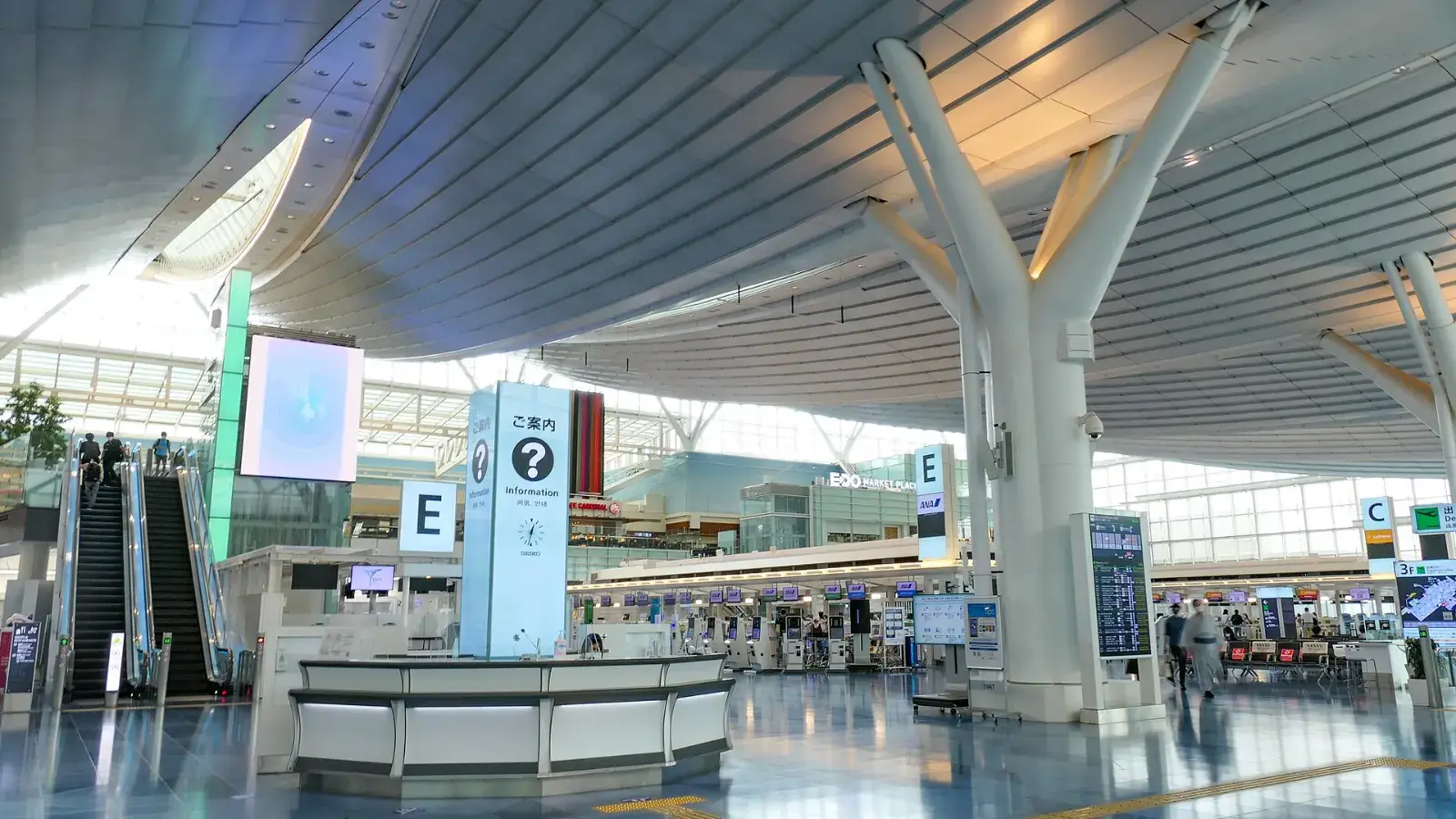
Short answer. For purchases made on or after 1 November 2026, you pay the full price including Japan’s 10% consumption tax (8% on food) and show your passport in the shop. Before checking in your bags on the way home, scan your passport at a customs tax refund kiosk, or use Visit Japan Web at the seven big airports, with the goods on you. Once customs confirms, the shop or its refund operator pays you back, minus any fee it charges. Anything bought up to 31 October stays under the old rules.
On 1 November 2026 Japan changed how tax-free shopping works for visitors. Shops no longer take the tax off at the till. You pay the full price, show your passport, and get the tax back after customs confirms at the airport that you’re taking the goods out of Japan.
The idea is the same as before: visitors don’t pay Japan’s consumption tax on things they take home. What changes is when you get the money and what you have to do on your last day. This guide is based on the Japan Tourism Agency, Japan Customs and National Tax Agency pages, checked on 29 October 2026, two days before the switch. Where something wasn’t published yet, we say so.
What changes on 1 November 2026?
The tax comes off later, and several old limits go. The Japan Tourism Agency’s wording is that "for purchases made on or after November 1, 2026, the system will shift to the Refund Method". In short:
| Bought up to 31 October 2026 (old rules) | Bought from 1 November 2026 (refund method) | |
|---|---|---|
| At the till | You pay the price without tax | You pay the full price with tax, and show your passport |
| Minimum spend | ¥5,000 before tax, per shop, per day | The same |
| Maximum | ¥500,000 before tax for consumables (food, drink, cosmetics), per shop, per day | No maximum. The limit is what you can carry out yourself |
| Packaging | Consumables sealed in a special bag you mustn’t open in Japan | No special packaging |
| Deadline | You must have been in Japan less than 6 months | Customs check within 90 days of the purchase |
| On departure | Customs can ask to see the goods | You scan your passport at a kiosk before bag drop, with the goods on you |
| Getting the money | Nothing to claim: you never paid the tax | The shop or its refund operator pays you after customs confirms |
Gold and platinum bullion are excluded, as before. Who counts as a visitor hasn’t changed either: you need to be a non-resident, which for most people means a short-term visitor’s status. Japanese citizens qualify if they’ve lived abroad for two years or more in a row.
I bought something before 1 November. Which rules apply?
The date of the sale decides, not the date you fly. The National Tax Agency’s Q&A says the refund method applies to sales on or after 1 November 2026, "not from the purchaser’s departure date", and that there’s no transition period where both systems run side by side.
| You bought it | You leave Japan | What applies |
|---|---|---|
| Up to 31 October | Before 1 November | Old rules |
| Up to 31 October | On or after 1 November | Old rules: you already paid no tax. Keep consumables in their sealed bag |
| On or after 1 November | Any time within 90 days | Refund method: you paid the tax, and you need the kiosk check to get it back |
| Some before, some after | On or after 1 November | Both. Only the November receipts need the kiosk check for a refund |
If your trip runs across the change, keep the two sets of shopping apart in your head. The October bags stay sealed. The November receipts are the ones worth money at the airport.
How does the tax refund work, step by step?
It’s three steps: buy, confirm at departure, get paid. The confirmation is the only part you can get wrong, and it has to happen before you check in your bags.
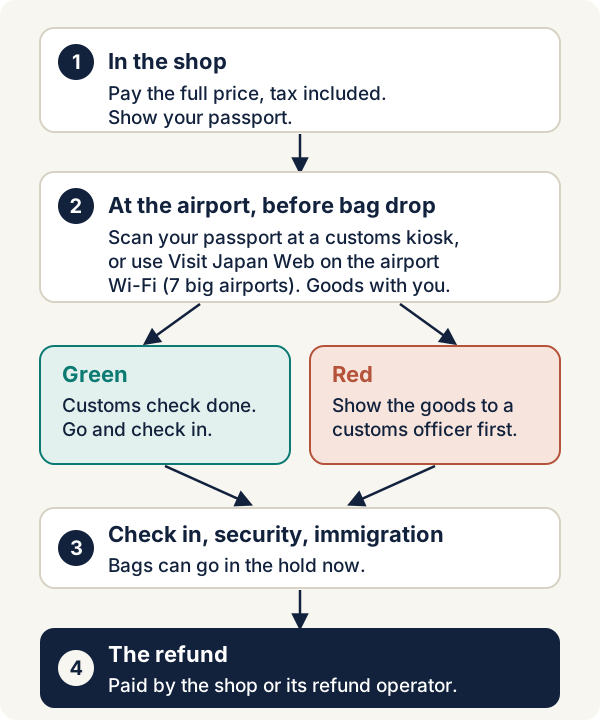
- In the shop. Spend at least ¥5,000 before tax in one shop on one day. That’s ¥5,500 at the till for most goods, or ¥5,400 for food. Pay the full price and show your passport, the same one you’ll travel out on. The shop sends the purchase record to customs electronically. Ask how it will pay the refund before you pay, because each shop chooses.
- At the airport or port. Before bag drop, go to a customs tax refund kiosk in the departure lobby and scan your passport, with all the goods on you. At Narita, Haneda, Kansai, Chubu, Fukuoka, New Chitose and Naha you can do the same step with Visit Japan Web on the dedicated airport Wi-Fi. A green result means customs is done. A red result means you take the goods to the customs inspection area first.
- The refund. Once customs confirms, the shop or the refund company it uses pays you. National Tax Agency material lists bank transfer, a credit card refund, an app transfer and cash at the port of departure as possible methods. Which ones you get depends on the shop.
Japan’s tourism office puts it plainly: complete the procedure before checking in your luggage, and allow plenty of time. It also warns that if the queue makes you miss your flight, neither customs nor the airline will compensate you.
How much will I get back?
The tax you paid, minus whatever the refund operator charges. Japan’s standard consumption tax is 10%, and food and non-alcoholic drinks to take away are 8%.
Here’s the maths for a few typical shops:
| What you buy | Price before tax | You pay at the till | Tax to claim back |
|---|---|---|---|
| A jacket (10%) | ¥30,000 | ¥33,000 | ¥3,000, less any fee |
| Snacks and tea for gifts (8%) | ¥30,000 | ¥32,400 | ¥2,400, less any fee |
| A camera (10%) | ¥120,000 | ¥132,000 | ¥12,000, less any fee |
| Just under the minimum (10%) | ¥4,900 | ¥5,390 | Nothing: under ¥5,000 before tax |
The fee is the unknown. No official page caps it, and as of 29 October 2026 the big refund operators hadn’t published a percentage. Don Quijote’s owner, PPIH, says its refunds are free except when you collect cash at the airport, where the operator’s own fee applies. If the fee matters to you, ask at the till before you pay, and compare a card refund with cash.
Food is worth a note. The government announced in August 2026 that it plans to cut the tax on food to 1% for two years from April 2027. That needs a new law and hadn’t passed when we checked, but if it does, the refund on snacks will shrink to almost nothing.
Which airports and ports have tax refund kiosks?
Japan Customs lists 78 departure points in its official kiosk map: 41 terminals at 36 airports and 37 terminals at 27 seaports. We put that list into one table with the floor, whether Visit Japan Web works there, the number of kiosks where it has been reported, and any cash refund machines on site. You can download the full list as a CSV.
These are the main international airports:
| Airport | Kiosk floor (Japan Customs) | Visit Japan Web | Kiosks reported | Cash refund on site |
|---|---|---|---|---|
| Narita T1 | 4F | Yes | Not published | Self Tax Refund machines, Central Building 4F, before security, 06:00–24:00 |
| Narita T2 | 3F | Yes | Not published | Self Tax Refund machines, Main Building 3F, before security, 06:00–24:00 |
| Narita T3 | 2F | Yes | Not published | None announced |
| Haneda T3 | 3F | Yes | Not published | Self Tax Refund machines, 3F departure area, after immigration, 24 hours |
| Haneda T2 (international) | 3F | Yes | Not published | Self Tax Refund machines, 3F departure area, after immigration, 06:45–25:30 |
| Kansai T1 | 4F | Yes | 24 | Cash Japan: 16 machines and a counter, 3F |
| Kansai T2 | 1F | Yes | 4 | Cash Japan: 5 machines, 1F |
| Chubu Centrair T1 | 3F | Yes | Not published | Cash Japan announced |
| Fukuoka (international) | 3F | Yes | Not published | Cash Japan announced |
| New Chitose (international) | 3F | Yes | 10 | Cash Japan announced |
| Naha (international) | 3F | Yes | Not published | Self Tax Refund machines, 2F departure area, after immigration, 06:00–21:00 |
At the 29 smaller airports in the list, from Sendai and Hiroshima to Kagoshima and Ishigaki, there’s no Visit Japan Web option. You use the kiosk, and there may be only one or two: Kobe and Takamatsu have two each, Hakodate and Asahikawa one. Japan Customs says some airports and ports have no permanent kiosk at all, and tells you to ask a customs officer there.
Leaving by sea works the same way, at the port where you leave Japan. Japan Customs’ leaflet for cruise passengers warns that goods in your cabin can also be inspected and that crowding is expected just before departure.
How much earlier should I get to the airport?
About 30 minutes more than usual at a big airport, by our estimate. No official page gives a figure: customs and the tourism agency only say to arrive early. We use 30 minutes because the kiosk queue sits before bag drop, and a red result adds an inspection on top.
Here’s what that means for four sample departure days. The first two columns come from Amicly’s departure planner rules, the same ones the app uses in its code: be at the airport 3 hours before an international flight, then leave early enough for the journey plus at least 15 minutes, or a quarter of a long journey, for traffic. The transfer times are our estimates for a hotel in the city centre.
| Departure | Journey to the airport (our estimate) | Be at the airport by | Leave by (Amicly rules) | Leave by, with 30 min for the tax check |
|---|---|---|---|---|
| Haneda T3, 18:00 flight, checkout 11:00 | 50 min | 15:00 | 13:55 | 13:25 |
| Narita T1, 11:30 flight, checkout 07:00 | 75 min | 08:30 | 06:56 | 06:26 |
| Kansai T1, 23:55 flight, checkout 11:00 | 50 min | 20:55 | 19:50 | 19:20 |
| New Chitose, 15:30 flight, checkout 10:00 | 45 min | 12:30 | 11:30 | 11:00 |
The Narita row is the one to notice. Amicly’s rules flag that the leave-by time is earlier than the 07:00 checkout, so you’d settle the bill the night before or ask for an early checkout. Add the tax check and you’re leaving before half past six.
If you’re flying out late in the day with shopping bags, see where to store luggage after hotel checkout. Anything you’re claiming tax on has to be with you at the kiosk, so leave only the other bags in storage. For airline deadlines in general, see how early to get to the airport for an international flight.
What can stop me getting the refund?
A few things, and most of them are about having the goods with you:
- A missing item. If even one item from a receipt isn’t with you, nothing on that receipt is refunded. Keep each receipt’s goods together, and don’t give away gifts from a mixed receipt before you fly.
- Using things in Japan. Food, drink or cosmetics used in Japan lose the refund. The tourism agency says not to run the kiosk for them, and to tell a customs officer instead.
- Checking the goods in first. The kiosk and any inspection come before bag drop. Once a suitcase is checked in, customs can’t see what’s in it.
- The 90-day limit. The customs check has to happen within 90 days of the purchase. Buy on 1 November and the last day is 30 January 2027.
- More than you can carry. The refund only covers goods you take out yourself when you leave. Sending purchases home by post or courier doesn’t count, unless the shop itself ships them abroad as an export.
- A different passport. Use the same passport in the shop and at the kiosk.
If customs confirms the goods and you then don’t take them out of Japan, the tax is collected from you and penalties can apply.
How do I actually get the money?
However the shop decides, so ask before you pay. As of late October 2026, these were the options travellers had been told about:
- Cash in the city. Global Blue and Yodobashi Camera announced cash refunds at 11 large Yodobashi stores from 1 November. You still have to do the customs check when you leave.
- Cash at the airport. Self Tax Refund machines at Narita, Haneda and Naha pay in yen. At Haneda and Naha they’re past immigration, so the kiosk comes first. Cash Japan runs machines and counters at Kansai, Kobe, Chubu, Fukuoka, Narita and New Chitose. Expect a fee for airport cash.
- To your card or an app, later, after customs confirms. No official source gives a time for this, so ask the shop how long it takes.
Cash in yen at the airport is only useful if you’ll spend it or change it, so for a big purchase a card refund is often the simpler choice.
Questions about the Japan tax refund
Do I still need to keep receipts? Keep them. The purchase records travel electronically and the kiosk works receipt by receipt, but a receipt is the easiest way to show what belongs together and to ask a shop about a refund later.
Can I open the bag or use the item in Japan? Under the new rules there’s no sealed bag, so opening a box is fine. Using up food, drink or cosmetics isn’t: those lose the refund.
What if the kiosk is out of order or there isn’t one? Ask a customs officer at the airport or port. Japan Customs says some departure points have no permanent kiosk.
Does Visit Japan Web replace the kiosk? Only at Narita, Haneda, Kansai, Chubu, Fukuoka, New Chitose and Naha, and only on the dedicated Wi-Fi in the departure lobby. Set it up before you get there.
Is there still a ¥500,000 limit? Not for purchases from 1 November. The old cap on consumables is gone, and so is the split between general goods and consumables.
How long does the refund take? It depends on the shop and the method. Cash at a city counter or airport machine is immediate, after the customs check where that comes first. For card and app refunds, no official time has been published.
Planning your last day in Japan? Amicly’s departure planner works out when to be at the airport and when to leave from your checkout and flight times, then plans the hours in between. Add the 30 minutes for the tax check when you have shopping to declare.
Sources
- Amicly dataset: tax refund kiosks at 78 departure points in Japan (checked 29 October 2026) · checked 29 October 2026
- Japan Tourism Agency: Tax-free refund method (for travellers) · checked 29 October 2026
- Japan Tourism Agency: Tax-free leaflet for travellers (PDF) · checked 29 October 2026
- Japan Tourism Agency: Tax-free FAQ · checked 29 October 2026
- Japan Customs: Locations of tax refund kiosks and customs inspection areas · checked 29 October 2026
- Japan Customs: Tax refund at departure for cruise passengers (PDF) · checked 29 October 2026
- Osaka Customs: Tax refund procedure at Kansai International Airport (PDF) · checked 29 October 2026
- National Tax Agency: Refund method Q&A, overview (April 2026, Japanese, PDF) · checked 29 October 2026
- National Tax Agency: Outline of the refund method (June 2025, PDF) · checked 29 October 2026
- National Tax Agency: Tax-free sales Q&A, current system (February 2025, Japanese, PDF) · checked 29 October 2026
- Ministry of Finance: Japan’s consumption tax, standard and reduced rates (PDF) · checked 29 October 2026
- JNTO: Everything you need to know about Japan’s new tax-free shopping system (July 2026) · checked 29 October 2026
- Japan Airport Terminal: Self Tax Refund cash machines at Haneda, Narita and Naha (21 October 2026, PDF) · checked 29 October 2026
- Aviation Wire: Cash Japan refund machines at Kansai and Kobe (20 October 2026, Japanese) · checked 29 October 2026
- Hokkaido Shimbun: tax refund kiosks at New Chitose, Hakodate and Asahikawa (26 October 2026, Japanese) · checked 29 October 2026
- Kagawa Prefecture: tax refund kiosks at Takamatsu Airport (27 October 2026, Japanese, PDF) · checked 29 October 2026
- PPIH (Don Quijote): refund method notice (8 October 2026, Japanese) · checked 29 October 2026
- Global Blue and Yodobashi Camera: in-store cash refunds (29 October 2026, Japanese) · checked 29 October 2026
- New Zealand MFAT: Japan, proposed consumption tax changes (August 2026) · checked 29 October 2026
- Wikimedia Commons: Tokyo International Airport T3 departure lobby (CC BY-SA 4.0) · checked 29 October 2026
- Wikimedia Commons: Shinsaibashi Shopping Arcade, Osaka (CC BY 2.0) · checked 29 October 2026
Spotted something out of date? Report a correction. How we review